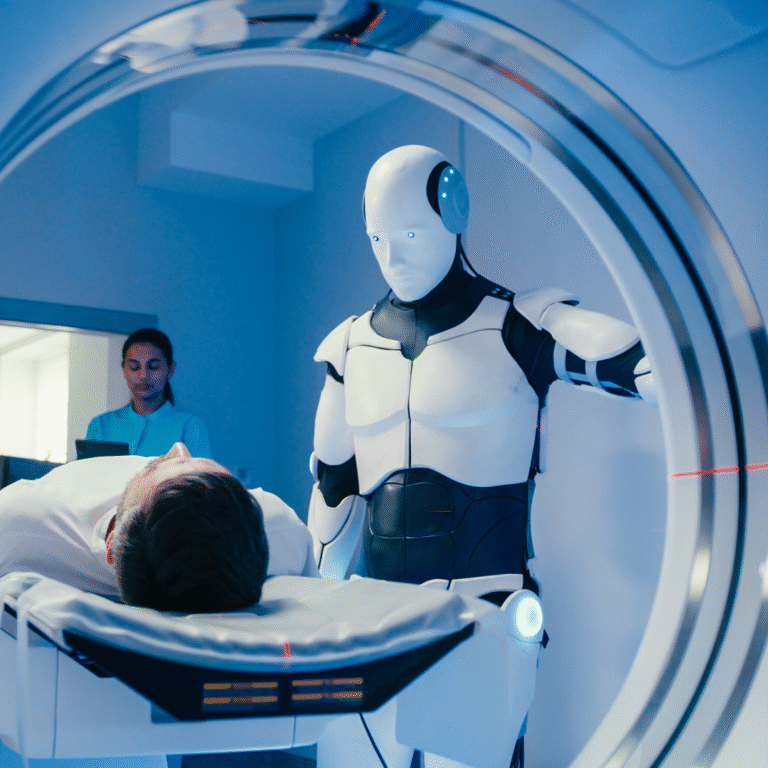
Docs Heart Bots
AI is poised to transform the healthcare sector—but what does that mean in practice? Fresh off hosting a healthtech event in Aboard’s Manhattan offices, Paul and Rich talk through the ways AI is reshaping this massive segment of the American economy. AI might lead to breakthroughs for researchers and diagnosticians alike, but is its real superpower…cutting down on paperwork? Plus: What happens when every patient arrives at their appointment armed with a diagnosis from Dr. ChatGPT?


Show Notes
Transcript
Paul Ford: Hello, I’m Paul Ford.
Rich Ziade: And I’m Rich Ziade.
Paul: And this is The Aboard Podcast. It’s the podcast about how AI is changing the world of software.
Rich: Sure is.
Paul: Rich: I want to talk about healthcare.
Rich: Let’s talk about healthcare.
Paul: Okay. Take off your shirt. [laughter]
[intro music]
Paul: Okay, you can put your shirt back on.
Rich: Oh, thank God.
Paul: Isn’t it great going to the doctor and you just get to—it’s like you just are turned back into a child. They tell you—
Rich: Well, get in the gown and then they leave you there for 10 minutes because they’re hopping across six rooms.
Paul: And it’s cold. And then that scruffy nurse comes in. There’s always, like, a kind of scruffy who’s like, “Yeah, okay, let’s get you on the scale.”
Rich: Let’s get you weighed and blood pressure and all that. It’s good times.
Paul: Yeah, it’s good times. I love it. That minute when you just, and you know, you’re just awaiting judgment.
Rich: Let’s help people out, though. Please don’t search “scruffy nurse” in Google or anywhere else. [laughing]
Paul: No. You can use ChatGPT. It’ll make you a picture.
Rich: Okay.
Paul: All right, so let’s take a step back. What is Aboard?
Rich: Aboard is a world-changing software-building platform that ships reliable, extensible software for people. We work with you, ask you what your problems are, what you need. Whip up some software—good, credible software, not just slop stuff. And then we ship it for you, and we get it to you faster and cheaper. It’s awesome.
Paul: I won’t go into why, but we’re not a vibe-coding tool.
Rich: We’re not.
Paul: We’re a software assembly tool. We use AI in very strategic ways. I’m also going to remind you I heard from your brother and he would like us to keep our hands on the table instead of at our sides during the podcast.
Rich: Why?
Paul: I don’t understand what’s wrong with him, but he would really like it.
Rich: That’s really funny.
Paul: Yeah. So anyway.
Rich: Hi, Bobby.
Paul: Hey, Bobby. [laughter] So we’re gonna work on that together.
Rich: Let’s do it. I got one arm on. I’m progressing.
Paul: I got two. I’m sitting here with both hands in front of me like a priest, so I know people are listening to this mostly, not watching it.
Rich: You could watch our fingers.
Paul: Yeah, I feel like I’m doing a very modern confession. Okay, so we did a healthcare event and it was really, I’ll tell you, it was a surprising one. You know why?
Rich: Yeah?
Paul: We thought we’d get about 20 people and we got about 160 RSVPs.
Rich: Whoa!
Paul: And the space can’t tolerate it. We actually had to send our employees home. We’re like, “There’s no place—”
Rich: “Get out!”
Paul: “You don’t get to eat this salami.”
Rich: Yeah, yeah.
Paul: “You have to go home.” And then we had a really, really high-fat cheese plate, which was great for a medical event.
Rich: I think doctors eat terribly.
Paul: Well they burn a lot of calories.
Rich: There were a lot of doctors at the event, it’s worth saying.
Paul: And they burn a lot of calories. They’re, like, always in motion.
Rich: They’re always in motion and I feel like they just stuff their faces when they have 10 minutes.
Paul: I think that’s it. I think that’s it. Yeah, no, if you ever watch a doctor eat, they’re like, that chicken parmesan just disappears.
Rich: Yeah.
Paul: And so anyway, it was a great event. Our friend Erynn Peterson, who hopefully we’ll have on the podcast soon, coordinated it and sort of brought the people in. She has a company called Emme that is focused on helping people use AI to navigate the health insurance system.
Rich: To get the best possible pricing on healthcare. Spell her company’s name.
Paul: E-M-M-E dot com.
Rich: Great.
Paul: So we had some really great guests. We’re going to put the video up online. So I won’t belabor sort of that event. If you want to go check that event out, we’ll make it available soon.
Rich: Sure.
Paul: But it was doctors. You introduced, you’re a lawyer. So we had doctors and lawyers.
Rich: Yeah, it was a love fest. Doctors and lawyers.
Paul: I moderated, I’m a journalist.
Rich: It was an immigrant parent’s dream.
Paul: It really was. [laughing] And actually it was, yes, it truly was, actually.
Rich: You must be a doctor or a lawyer. Yeah, it was very well attended. Mix of hands on practitioners, academics. I met a few people who were in healthtech AI startups.
Paul: Yeah, we have healthcare clients and so on. But I haven’t really been leaning into what’s been happening in the space.
Rich: Yeah.
Paul: And this event, moderating it, I really needed to lean in. I needed to understand what’s going on. I wrote about this in the newsletter, but I’ll just give you like a few things that I learned.
Rich: Okay.
Paul: First of all, healthcare, let’s just nail it down. I think, like, 19% of US GDP and $5 trillion.
Rich: It’s a massive chunk of the economy.
Paul: So it’s just, for better or for worse, right? And we tend to really talk about it as a culture altogether when we—either Republicans are trying to stop Obamacare.
Rich: Yeah.
Paul: Or a guy shoots a healthcare company CEO. Like, those are the times that we talk about it.
Rich: Yeah.
Paul: But you should really think, like, 20 cents on the dollar. Right? Every dollar in America is going towards something that beeps in a hospital.
Rich: I mean, look, it underpins life. We’re not going to cover the fact that healthcare in the U.S. is a bit of a runaway train. That’s a different topic. Healthcare costs and all that. And insurance and the way people insurance struggle with insurance—
Paul: This is a little digression. Number one thing I hate about running a company? All the hard parts, hiring, firing.
Rich: Yeah.
Paul: Getting serious feedback, you know, failing, all that’s okay. I hate being responsible for the healthcare of others.
Rich: How come? Too weighty?
Paul: It’s not just that. It’s really bad for business. You end up making decisions about healthcare.
Rich: Yeah.
Paul: Because you are a healthcare provider, which is a civic function, not a business function.
Rich: Yeah.
Paul: And you end up, like, having to factor that into every single decision you make. How am I going to provide healthcare? Does that person have adequate healthcare for their family?
Rich: By the way, if you’re a small company in the United States, it’s hard to get good managed healthcare. Like it’s—
Paul: It’s brutal.
Rich: They won’t do it. You have to have scale for certain health-insurance providers to give you a blanket agreement that covers all your employees. If you got, like, six employees, it’s hard. Like, restaurants and storefront businesses really struggle with this.
Paul: It is the most anti-entrepreneurship I think possible, because it just forces you to make decisions based on something besides the growth of the business, over and over and over again.
Rich: Yes. Yes.
Paul: Anyway, that’s my little digression. Just wanted to get it out there. Okay. So $5 trillion. So obviously we got AI coming, which is now, you know.
Rich: I mean, OpenAI made a huge healthcare announcement. It wasn’t, it was kind of murky in terms of what it was.
Paul: Well, let’s talk about the categories for a sec.
Rich: Yeah.
Paul: Because I think when people think about healthcare tech?
Rich: Yeah.
Paul: They think about things that beep. They think about radiologists who are able to, like, pinpoint a dot, and now the computer’s like, “Looks like cancer!”
Rich: Yeah.
Paul: Right? And so, like, they’re thinking about, like, super brain computers doing doctor stuff. The major application to the point that it’s now completely taken for granted is essentially dictation.
Rich: Mmm.
Paul: Doctors—so there’s a concept I learned, I wrote about it, but let me just put it, it’s called pajama time. Do you know what pajama time is? I know you do.
Rich: I’m gonna search, “scruffy nurse pajama time.”
Paul: Yes, you are.
Rich: When I get a chance.
Paul: Okay.
Rich: But I do know what it means, but describe it for the audience.
Paul: So doctors have so much paperwork. Like, even cops don’t have this much paperwork.
Rich: Yeah. And they have to do it.
Paul: They have to, like. And it’s part, one of the reasons they have to do it is, like, litigation risk, like—
Rich: Liability, and, yeah.
Paul: But you have to write down everything that happened.
Rich: Also if you’ve got 300 patients, when patient number 174 visits you three years later, you got to pull up their file and catch up.
Paul: Doctors are basically very slow statisticians. That’s what I’ve learned.
Rich: [laughing] Yeah.
Paul: It’s just sort of, like, they just kind of run an average of, like, your blood pressure over seven years.
Rich: Yeah, yeah. I had a doctor who, minutes would pass because his notes were so copious—it was a neurologist, and he would write for, I’m like, “What are you writing?” And he’s like, and he’d just give me, like, the side eye. Like, “Just relax.”
Paul: “Don’t worry about this.”
Rich: Yeah, exactly. But he would, it was very meaningful to him to write exhaustively, because I think he really needed to recapture where the case was when he came back to it. I think that was a big part of it.
Paul: It was entirely ER fanfiction.
Rich: [laughing] It might have been.
Paul: It was all it was. You turn around, it’s just like, and then, you know. Okay. Anyway.
Rich: Anyway. Yeah, so, yeah, note taking. Which, by the way—
Paul: The pajama time is, you have to do it when the day’s over.
Rich: Okay, so that’s what I was gonna ask, like, why pajama time? It’s because you’ve got so much catching up to do, so much stuff to file away. You do it at night.
Paul: But I do love that doctors just conceive of themselves as all wearing jammies.
Rich: That’s adorable.
Paul: I don’t know. Do you wear pajamas?
Rich: No. I used to.
Paul: Really?
Rich: Yeah.
Paul: When the hell did you wear pajamas?
Rich: They were silk pajamas.
Paul: Silk. Well—
Rich: I would wear them out by my pool, [laughter] and there would be champagne.
Paul: Yeah, when you were, when I was just, you know, dating.
Rich: No, it was actually a cultural thing. We used to wear pajamas.
Paul: Wait, are the Lebanese a jammy culture?
Rich: Yeah. Dude, the Middle East is all about kind of letting things flow for the male.
Paul: That is true. You guys do—
Rich: It’s heat. It’s, like, to dissipate heat.
Paul: You like to drape.
Rich: A lot of draping.
Paul: Yeah.
Rich: Yeah, so my dad, as soon as he got home, would get in pajamas.
Paul: No kidding. Well, it’s also, everybody kind of—
Rich: I don’t. I mean, it’s like shorts and sweatpants or whatever.
Paul: Yeah, me, too. But anyway, regardless.
Rich: Yeah.
Paul: That’s not really what this is about.
Rich: It’s really not. [laughter]
Paul: Well…
Rich: It better not be.
Paul: Okay. I learned something about the Lebanese today. I did not—I know a lot about Lebanese culture.
Rich: You sure do.
Paul: I didn’t know it was a PJ culture.
Rich: I don’t know if it’s Lebanese. I think that’s, I think that’s…Middle Eastern, I would say.
Paul: Yeah.
Rich: Probably in hotter climates…?
Paul: I think there’s also, like, if you grow up, you know, mainstream Protestant American, the idea is that you are going to sleep in a cold environment entirely alone.
Rich: Mmm.
Paul: Whereas if you’re Lebanese, you might, people may fall asleep all over the place.
Rich: Yeah. It’s not just that. It’s, the home is, it’s not a—it’s a very chill place.
Paul: Yeah.
Rich: That’s kind of what it’s about. Like, getting out of your clothes when you get home is kind of a thing.
Paul: Like, getting into house shoes.
Rich: Yeah.
Paul: Yeah.
Rich: Yeah, yeah, yeah. It’s all about sort of relaxing into your… Think of it, like, you know how, like, in Morocco they have, like, I don’t know what it’s called. It’s like the living room is kind of a pit?
Paul: Yeah, yeah.
Rich: They sort of. It’s like, covered in carpet.
Paul: Mmm hmm.
Rich: It’s like that kind—
Paul: Or, like, those Algerian houses.
Rich: Shoes are off.
Paul: The Algerian houses with, like, big courtyards…
Rich: A lot of toes.
Paul: That’s a lot of toes.
Rich: A lot of toes.
Paul: Yeah. If you’re, if you grew up in a Western society, you should never see feet.
Rich: Yeah, exactly, exactly.
Paul: Not even swimming.
Rich: Yeah.
Paul: Yeah.
Rich: We are really off topic here.
Paul: Well…yes. [laughter]
Rich: Pajama time. So they’re using AI to effectively take scribbles and turn them into nice bulleted notes.
Paul: This goes back to—
Rich: Transcribing and things like that?
Paul: It’s something super fundamental, right? Which is one of the points that we make over and over and over is that summarization is the killer application here.
Rich: Yeah.
Paul: You use the LLM and you say, could you please make this shorter? Could you please organize this? Could you put it into a box for me? Not creation. Right? People in the culture industry are like, stop illustrating for me. You suck.
Rich: Don’t start with a blank canvas. Yes.
Paul: That’s right. People in tech are, like, okay, actually, writing code is horrible. So it’s cool that you do it, but you better calm down and let me take control. Doctors are like, you are not about to diagnose this patient. I’ll be doing that. I went to medical school.
Rich: Yeah.
Paul: But my God, if you could type up my notes.
Rich: I did get asked the last couple of visits, “Do you mind if we record this visit?”
Paul: Yeah.
Rich: “A transcription tool is going to take, record everything and then summarize it.” So they’re asking for permission. It’s an annoying thing to do. I mean, it’s a thing—I like this application because that means doctors can actually focus on where their higher-order skills are and not sit there and take notes. Doctors bring in an assistant to sort of be there to take the notes. Many don’t.
Paul: Interesting, though. When you and I summarize a document, let’s say you and I are doing a conference call and I hit record, and Gemini summarizes.
Rich: Yeah?
Paul: Good for us. What is our risk from using that transcription? Zero.
Rich: Risk?
Paul: Zero.
Rich: Yeah, yeah, yeah, yeah.
Paul: Doctors, we learned this, the hospital systems they work in don’t cover that liability. So if the AI writes up the notes?
Rich: And makes a mistake?
Paul: They have to review them, because otherwise they are liable for the mistakes in the notes.
Rich: That’ll go away eventually.
Paul: But what I saw there was again, because the paradigms around medical care are so intense?
Rich: Yeah.
Paul: And because the rules are so explicit?
Rich: Yeah.
Paul: It’s very easy for them to bring AI into the system because it’s, like, summarize my notes. I got to read them.
Rich: Yeah.
Paul: And because otherwise I could get sued.
Rich: 79% of doctors are not reading them.
Paul: That’s a very specific—
Rich: 73%.
Paul: Really?
Rich: Many are not reading them. They’re fine. They’re just utterly fine.
Paul: Yeah?
Rich: Yeah. Look, here’s, I think, what will materialize. What will materialize is—
Paul: Somebody’s going to die.
Rich: —are really—
Paul: Somebody’s going to die because of that. And then there’s going to be, liability insurance will kick in, and then the doctor will be in big trouble. Like, that’s, that is going to happen.
Rich: This is what I just, I was just about to say this. I don’t know if that’s gonna happen.
Paul: Okay.
Rich: I really don’t know. If it does happen, then everybody’s gonna double back, like, take a step back and say, “Oh, we gotta have a better protocol.”
Paul: See this is where your—
Rich: Then somebody will come up with a product. Humans tend to—
Paul: This is your lawyer brain going like, “Yeah, you know, it could happen. Somebody could die here. And then we would—” I’m not saying that’s good or bad.
Rich: The world will react to that, right? I mean…
Paul: You’re being descriptive, not prescriptive.
Rich: Correct.
Paul: Yeah. No, no. Okay, let’s look at reality. Doctors are going to summarize their notes with these tools. Over time, doctors being human, some will read every note. The really good students.
Rich: Yeah.
Paul: But some are lazy goofballs anyway. And so even though they got through med school, wasn’t a good med school, and they would just be like, “Fine, whatever.”
Rich: Yeah. And you know, there will be products where, like, “This is an airtight transcription tool that summarizes and uses super duper, you know, hyperscale technology to make sure that no information is misrepresented.” Like, there’ll be products, Literally products. And say, you know what? This is for you. We met a couple. There were some startups that were here that were focused on medical transcription, not just transcription.
Paul: So medical transcription. Yeah, that’s the thing. These are very specific medical transcription.
Rich: Yeah.
Paul: And then legal transcriber bots will come in and review the medical transcriber bots.
Rich: What?.
Paul: That’s what I think is going to happen.
Rich: Oh, sure.
Paul: Yeah. You’ll get your virtual lawyers to look at your virtual doctors.
Rich: I mean, literally, like—
Paul: It’ll be weird, though—
Rich: These exact issues, like a deposition that’s recorded for three hours that then is summarized? Same, exactly the same issues arise. Can you trust the translation from long text to summary? It’s similar.
Paul: I know, but then it’s like, “Should we cut off Grandpa’s leg?” And ChatGPT is like, “Sounds great!”
Rich: Well, I won’t do that.
Paul: Mmm.
Rich: Yeah, you’re not—look, I think I’m going to defend AI here. When you give AI—
Paul: That’s brave of you.
Rich: [laughing] When you give AI a blob of content and tell it to just work within that content and don’t stray anywhere, it does just fine. It’s just absolutely fine. I’m not suggesting, “Hey, doctors don’t review the stuff,” and all that. Obviously you should—here’s what’s gonna happen. They’re gonna review it for three months. They’re like, “You know what? I haven’t changed a single thing in three months. So I’m gonna review it less now. Because I did this. I QAed it for three months.” That’s what’s gonna happen.
Paul: Even more specifically, they’ll write an article reviewing the transcription results and be like, “This exceeds the quality of this kind of historical transcription, therefore, we’re done.”
Rich: Yeah.
Paul: Doctors are funny that way. If they see the change and they get statistical validation?
Rich: Yeah.
Paul: They’re like, “Cool, calling it a day. We’re going to use this for the rest of our lives.”
Rich: And look, here’s the reality. And we’re seeing this in code, too. Why code is getting better is that you can take that output, lift it out of that context, put it into another…you can essentially test it on the fly. And that’s happening with code, and it’s going to happen with this stuff, too. So you can say, okay, I’m coming at this horizontally, and this time I’ll come at it vertically and review the same two pieces of content, right? So that’s going to happen in seconds, and it’s going to get better and better and more reliable. Everybody chill.
Paul: We learn two things today, okay? And then we’ll talk, I want to talk about a third. So one is the Lebanese wear pajamas. [laughter] Two is doctors are using robots to transcribe their notes from all sorts of things.
Rich: For sure.
Paul: We both think that that space, doctors think that, like, that’s not going away. That is now permanent infrastructure in the healthcare industry.
Rich: It’s an assistant.
Paul: We’re also learning things like people are making bots that call the insurance company to talk to the insurance company bots in order to negotiate your authorization for your colonoscopy. That’s weird. Just throwing that out there. But let me go forward just a little bit. People are diagnosing themselves constantly with ChatGPT.
Rich: Yeah, they are. I mean, look, since the web came together and WebMD, you’d go down that bulleted list and you’d end up at malaise.
Paul: Oh, yeah, WebMD was amazing. [laughter] But also it was always like, “Go see a doctor.” “Oh, my foot hurts.” “Go see a doctor.”
Rich: Well, yeah, I mean, it would just get, it was always the same progression from very specific to very broad.
Paul: We made a rule in our house, especially when we were trying to get pregnant. Mayo Clinic only.
Rich: I mean, Mayo Clinic’s great. And Mayo Clinic is—
Paul: Because otherwise you go on forums and they’re like, “Did you try rubbing your uterus with Dr. Bronner’s soap?”
Rich: So, yeah, yeah. And look, if you’re a worrier. And we all are. We all are alone with our laptops in the dark—
Paul: [laughing] Jesus Christ.
Rich: Let me finish that sentence.
Paul: No, no, no.
Rich: Worriers.
Paul: Okay, we’ll be right back!
Rich: We’re worriers.
Paul: Okay, we are, yeah. And—
Paul: Who’s on their—everyone, you’re on your phone in the dark. What are you doing with a laptop?
Rich: Or your phone. Either one.
Paul: Are you vibe coding?
Rich: I had a friend, an acquaintance, who was like, “I think I have this condition.” And it was like, pain radiates from shoulders down up to the base of the neck, and this—and you’re reading it on. I’m reading and reading. Like, “I’m pretty sure I have this.” And it was, like, a 3 A.M. message.
Paul: Yeah.
Rich: And I clicked on the link he shared. I click on the link and it had one of those names that were like, they combined two dead World War I soldiers names together.
Paul: Oh, yeah.
Rich: It was like Josephson-Wilkes Syndrome.
Paul: Coddington, yeah, yeah. [laughter]
Rich: Yeah. And I say the World War I reference for a reason. It was like, literally, if you read the description, “It was prevalent amongst World War II soldiers.”
Paul: Okay.
Rich: And this person that asked me about this was 25.
Paul: Yeah. He’s like, I’ve never been—
Rich: This is the problem. So people have done this forever, but AI, it’s more intimate. It’s got better bedside manner. It’s talking to you. That’s a very different experience than sifting through webpages. And so I’m not surprised.
Paul: Well, A) let’s be clear. People hate their doctors. They don’t like going to the doctor. It’s a bad thing. They make you get naked, then they look at you, and then they tell you something’s wrong with you.
Rich: Yeah. We should talk about the fact that your ophthalmologist makes you get naked. That’s a separate issue and maybe a separate topic.
Paul: There was a point where my ophthalmologist yelled at me because my eyes were too fat. [laughter] That was truly one of, like, the worst—
Rich: Like, the lids?
Paul: Like, 30 years ago. He’s like, “Look at your eyes. They’re fat!” I was just like, “Man—”
Rich: That’s a terrible thing to say.
Paul: “You got to help me out.” And then he was like, “Have you ever been, were you in the Marine Corps?” Just a really bad experience. And then I didn’t get glasses for like, 15 years.
Rich: There’s some—I’ve used it. I’ve used AI to….
Paul: Diagnose?
Rich: I have, like, chronic sinus issues. And so we had a long, 45-minute conversation about this.
Paul: You and ChatGPT?
Rich: Here’s the one magic trick that I thought was incredibly effective about it.
Paul: Mmm?
Rich: It started to say things like this: “Hey, listen, it could be a host of things. It’s probably these. Please don’t pull alarms. Chill out. Like, statistically, you’re fine, but you should probably, if this lingers for another week, maybe you should go see someone.” It was really good. It was really good.
Paul: Okay.
Rich: Not just in terms of trying to triangulate on what was going on, but also in terms of, it was empathetic in such a freaking bizarre way to calm me down. I was like, “Why are you going there?” And it’s probably because it’s learned from maybe forums or other, like, sources of content beyond—
Paul: My guess is that they fed it, like, doctor stuff.
Rich: They probably fed a doctor. So the statistical weighing that’s going on and it’s. But it’s what’s powerful about it—
Paul: Because 90% of the Internet is like, “Oh, prostate problems. You need to eat more watermelon.”
Rich: Yeah, right. Exactly.
Paul: So it can’t be that.
Rich: Exactly. It can’t be that. But what I thought was impressive, and maybe they tuned the LLM to respond this way, which is it very much worked hard at translating intense medical speak and terminology to a patient. And so they did that work. And so I’m not surprised everybody is leaning into this thing. And also, it’s weird, context in this context, for lack of a better word, is strange because now I can go back to that chat and it has background. It’s like, “Hey, this might be related to that neck thing you told me about a month ago.” Which is crazy. You gotta say for us as technologists, we know what’s going on.
Paul: Yeah.
Rich: But now this thing has built a professional relationship with me over the long term.
Paul: Okay, you’re making this sound like a good thing.
Rich: No, I’m gonna get to—
Paul: Okay, I need you to get to the bad thing.
Rich: Well, no, I think the good thing is the bad thing.
Paul: Okay.
Rich: The good thing—
Paul: Boy, that is the story—might as well title the book about our industry that.
Rich: The good thing is the bad thing. And what I’m saying by that is, I know what’s up. I am deep into understanding these technologies. I know the tricks.
Paul: And now you’ve asked it to fix your nose.
Rich: And I don’t want to sound condescending.
Paul: No. That would be very unlike you.
Rich: But for most of the world, you’re very vulnerable when you’re talking about health stuff.
Paul: Yes.
Rich: Your own personal health stuff.
Paul: To the point that they really don’t want to go to the doctor.
Rich: Most of the world is buying into this as if they, like, it’s really getting blurry between whether you’re talking to, like, that is the scary, scary part.
Paul: I saw a really prominent person talk about how ChatGPT told them to stop taking baby aspirin. And then they—it’s kind of a “did your own research” situation.
Rich: It totally is.
Paul: And you’re just sort of like, “Oh, no, no, this is bad.”
Rich: Yeah, yeah, yeah.
Paul: So I think, like—
Rich: That’s the danger. Like, it was all, like, there was a disclaimer over it for me throughout, because I know the tech and I understand it.
Paul: I mean, again, we’re back to summarization, right? Here’s what’s difficult. I think diagnosis is tricky because what they keep finding is like, it’ll pick the most obvious stuff, but it’s not good at seeing patterns like a doctor is. Like, a good doctor sees—
Rich: It also doesn’t have your damn blood test.
Paul: That’s right, that’s right. And they just don’t, like, they don’t know your history, et cetera, et cetera. It’s very good at like, “Hey, you know, I just went to the doctor and I heard I have this.”
Rich: Yeah.
Paul: “Tell me about this condition.” Right.?
Rich: Tell me more about it.
Paul: Give me some resources.
Rich: Help me understand it.
Paul: Back to summarization. Back to explanation. Back to, you know—
Rich: I think people, you called it. They’re not doing it that way. What they’re doing is like, “Maybe if I can sort this out myself, I don’t have to go to the doctor.” I think that’s what most people are doing.
Paul: I think what’s really tricky, too is it’s very, very easy to get from like, “You know, I have a lump in my armpit, to like, “My friend told me that drinking vinegar can help.” Right?
Rich: Sure.
Paul: And you know what it’s going to do is be like, you can actually, you can hear it in your head. You can hear, like, “Well, vinegar doesn’t really have a lot of medical applications that are widely respected by the medical community. However, it is a really well-known folk cure. And blah blah blah blah blah.”
Rich: Yeah.
Paul: Then you could be like, “I’d like you to give me some explanations about how—”
Rich: It’s so conversational. It doesn’t shut stuff down.
Paul: “How should I take the vinegar?” And I’ll be like, “Oh, okay. Well, now the context shifted and it’s vinegar time!”
Rich: That’s right.
Paul: And you know, you really need to go get that lump looked at.
Rich: It is the most savvy confirmation-bias machine ever created.
Paul: So now we have this very tricky situation where people are gonna be going to doctors with all their chats.
Rich: Yeah.
Paul: And they’re gonna have a whole lot of priors already validated by the robot, and they’re gonna want the doctor to tell them what the robot told them.
Rich: Yeah, I actually talked to one of my, what used to be my primary about this. Patients that are nervous yap away at their doctors. And doctors, I don’t know if you notice their demeanor. And I’ve noticed this with most doctors that I deal with. They pretty much ignore you.
Paul: My doctor, because I’ve been seeing him for a while, complains about his children.
Rich: Yeah.
Paul: Yeah.
Rich: No, but as you’re trying to steer diagnosis or you’re trying to get a, you know, finagle a prescription for antibiotics or something, they really tune you out.
Paul: Yes.
Rich: And good doctors should tune you out.
Paul: Yes.
Rich: They don’t want to hear about how you figured it out and you’re just coming to them for validation.
Paul: You are a lump of meat with numbers floating above your head.
Rich: Yeah, exactly, Exactly.
Paul: No, but I mean that about you.
Rich: Oh. [laughter] AI doesn’t have that tact.
Paul: No…
Rich: That’s the problem.
Paul: It is a good listener!
Rich: “Wow, that’s a good point! Vinegar! Are we talking about white vinegar?”
Paul: What AI is doing is matching language to an enormous corpus of medical information.
Rich: And—
Paul: That is very different than, “Boy, I’ve seen about 1,000 cases of athlete’s foot just like this one.”
Rich: Yeah.
Paul: “This one’s pretty normal. I know what they need. You’re gonna just need to get more Tinactin, buddy.” And it’s very dangerous—
Rich: It’s hyper-engage—its tendency to over-engage.
Paul: And it’s incredibly steerable, because I’m gonna bet you if we sit down, I can steer an AI, if I really wanted to, to be like, “It really could be cancer.”
Rich: Yeah.
Paul: “It really could be cancer. You need to go deal with this right now.”
Rich: You can always get there.
Paul: Yeah.
Rich: Right? And that’s a scary thing. It’s not a healthy thing. Now I feel like I’m saying this more often these days. The mistake we continue to make, and we mostly talk about AI in the context of building software.
Paul: Absolutely.
Rich: We’re talking about AI in the context of healthcare right now. The mistake we make over and over again is that we assume that at a given moment in time, AI is not going to evolve. As if the moment we’re talking about it, it’s going to stay that way and it’s not going to change.
Paul: It sure has smacked us in the face five or six times as we’ve tried to build an AI product.
Rich: Exactly.
Paul: Yeah.
Rich: Now I will tell you that I could say with pretty much, pretty strong confidence, based on what we’ve seen in the tech, in the engineering space, in the coding space, is that they’re gonna get better. They’re gonna be less conversational. They’re going to be a little more coy. They’re gonna improve. They’re gonna improve because there’s, I’ll tell you why. Not because science marches on. Because there’s a lot of money at stake. There’s a lot of frickin’ money.
Paul: It’s not just that. The world—I think, let’s close on this, and I want you to respond to it. The worlds haven’t lined up yet. What’s the biggest technology player in sort of mass healthcare, do you think? You know it. You’ve got one in your pocket.
Rich: My keys?
Paul: Apple.
Rich: Yeah.
Paul: They are monitoring the hell out of you. My Apple—
Rich: Yeah, sure.
Paul: They know. They know all sorts of stuff.
Rich: Sure.
Paul: They love you to tell them—there’s probably more public health data in iOS devices now than…
Rich: Watches and all that.
Paul: Okay? But Apple just sucks at AI. They just, they’re so busy going to watch—
Rich: They flubbed it.
Paul: They got to go watch that Melania movie at the White House.
Rich: Oh! You went there. You went there.
Paul: Well, so did they! So did Tim Cook! He was like—
Rich: He did go there.
Paul: He really did. And he watched that movie and. And can you, no one, that’s the only—
Rich: He could have missed the flight, man.
Paul: No one—well, no, he can’t. [laughing] He really—
Rich: Yeah.
Paul: Tim Cook can never miss a flight.
Rich: Yeah, it could have been something else.
Paul: No, that plane’s waiting right there to take him.
Rich: Yeah.
Paul: There’s no way out. That’s the only people who will ever watch that film. So good for them.
Rich: [laughing] Tim Cook and, like, three assistants.
Paul: I just, can you imagine that? I can only imagine. It’s just her just shrieking is what I imagine that film to be.
Rich: No, it’s not even that.
Paul: Yeah, it’s true.
Rich: It’s like a long ad.
Paul: You’re right.
Rich: I guess. I want to watch it just to gawk at it.
Paul: No, we’re pirating that, then. Nobody’s getting money. Sorry. All right. Distraction. Anyway, Apple has a vast trove of information.
Rich: It does.
Paul: But it really sucks at AI because it’s so busy sucking up to the Trumps. And so over here—and it’s actually a real problem for them. Like, they’re—
Rich: They signed a deal with Google.
Paul: That’s right.
Rich: They’re going to sort of fill the gap.
Paul: Which is embarrassing.
Rich: I’m not surprised. We can talk about that.
Paul: You lose the capacity of embarrassment at a $3-trillion valuation.
Rich: Apple moves slow. They always have.
Paul: Okay.
Rich: Maps was, like, seven years late. They’re just known to move slow.
Paul: But what I’m saying is—
Rich: But yes, they are sitting on a trove of health data.
Paul: And to be clear, OpenAI, Google, and Anthropic are really doubling down on health and AI. Like, the things we’re talking about. Diagnosis, automatic drug discovery, all kinds of stuff.
Rich: The OpenAI sensor thing that you’re gonna attach to your ear or your ring—
Paul: Oh, it’s Jony Ive.
Rich: Yeah. It’s gonna read blood pressure, and it’s gonna read this and read that. My mattress asks me if I drank last night.
Paul: It’s gonna be the worst keynote. It’s just gonna be him being like it, [Jony Ive impersonation] “It inserts, you know, five pounds of aluminium into your—” I mean, it’s just gonna be absolute—
Rich: Oooh!
Paul: Yeah, no, that’s what it’s gonna be. That’s what it’s gonna be. [laughter] And so… “Sensing every clench.” And so we’re headed for that, right? We’re headed for Sam Altman listening to your nipples and sort of all this stuff.
Rich: Yeah.
Paul: And I think—
Rich: I think you’re right. I think that’s—
Paul: But that, I think that’s the world to get ready for and that’s the world that’s gonna change, which is—
Rich: Yeah.
Paul: The question is, do I walk in and does MyChart already know what my Apple device is saying? And is my doctor already ready with five potential care plans—
Rich: Yeah.
Paul: —that they choose from? Or maybe actually given our healthcare system, is it the nurse practitioner who’s doing most of that work and getting literal sign off on the AI doctor plus the real doctor?
Rich: Yeah.
Paul: So that’s Plan A. Plan B is I never go to the doctor anymore because my doctor is now Dr. Apple.
Rich: Yeah. No, yeah, I think it never goes that way because hospitals and doctors and institutions and laws are very slow and brittle and so—but I think there’s a lot of good. “Look, your blood pressure is elevated. I want to track it for a while.” Right? “Would you mind if I flip on a switch?” Like, it’s literally they click something on their side of the app and now all of a sudden they get daily blood pressure updates. That’s really good, right?
Paul: We have friends, their kid has Type 1 and it’s a very, like, monitored—
Rich: That data should flow back, right?
Paul: I mean, it does, it does.
Rich: It does. It does. Yeah. So that part’s good.
Paul: Didn’t you used to wear, like, a weird brain cap at one point and then, like, you’d send a USB stick back to the neurologist?
Rich: Yeah, I mean, yeah, I did. And it was—
Paul: Sorry if that was a little—
Rich: It wasn’t a USB stick. The whole frickin’ device had to go back in. It was terrible. Like, it was messy and sloppy and you did it for a day.
Paul: Oh, really?
Rich: Rather than—yeah, you did it for 24 hours. What does a doctor really want? They want to monitor that for, like, two weeks straight and see activity.
Paul: Yeah.
Rich: The tech is there, it’s just not in hand. So there’s a lot of positives.
Paul: I think, but you know what, just to close that out.
Rich: Yeah.
Paul: We’re describing processes that exist. Doctors like to monitor. They like to bring the data in. There are all sorts of products and processes that compress the data and then analyze it statistically.
Rich: Yeah.
Paul: There are people out there doing self-diagnosis, but doctors are also using LLMs to explore the literature. Don’t think of it as this great radical disruption where AI is going to drop into healthcare and Dr. Claude is going to tell you how to live your life.
Rich: Yeah.
Paul: Think of it as a continuation of all of these processes of data aggregation and stuff being in MyChart and automated systems and so on. We’re just going to get more and faster.
Rich: Yeah.
Paul: And that’s obviously where it’s going. So I think—
Rich: Yeah.
Paul: Yes, there will be these big disruptions and these big slaps across the face, but it’s going to look like that. It’s going to look like MyChart that asks you to send a picture of your tongue.
Rich: Yeah.
Paul: That sort of thing.
Rich: Yeah. Let me tee up, I think we should talk about this another time as well.
Paul: Okay.
Rich: And let me tee up a question that could kick off the next podcast. We talked about people using AI and bypassing their doctors. We talked about doctors taking notes. I think a really interesting question, and it came up at an event, is doctors have to triangulate on a diagnosis off of oftentimes murky information.
Paul: Yeah.
Rich: They talk to you. Maybe they’ll draw blood, if it helps.
Paul: We’re terrible explainers.
Rich: We’re terrible explainers.
Paul: It’s easier to be a veterinarian.
Rich: And so the question that comes up is if I’ve got a handful of inputs. Some of it’s coming off my watch, some of it’s coming off of notes from visiting. Some of it’s coming off of a blood test. Triangulating on those AI, if you gave it, those inputs could be very, very good at guiding the clinician, not the person. Right?
Paul: Yeah, agreed.
Rich: That was a heated point at the event, because you’ve got experts and people and practitioners saying, “We got to draw a line here. I don’t want suggested outcomes from some machine. That’s why I’m here.” And so I think that discussion—
Paul: That’s also what a lot of people said about letting it write JavaScript for them.
Rich: That’s what a lot of people said about, and someone asked it at the event, cabbies being angry at GPS.
Paul: Yeah.
Rich: Right? So this is a fascinating waypoint to talk about and I think we should talk about it on another podcast.
Paul: Okay. And I want everyone to go out and get a colonoscopy.
Rich: Yeah, and if you use the Aboard coupon code HEREWEGO [laughter] you can get 20% off.
Paul: That’s important. It’s important. As you’re getting—
Rich: This is a terrible transcript of this podcast.
Paul: A lot of our audience is getting older. It’s important. I want you to be healthy.
Rich: Take care of yourselves.
Paul: Take care of yourselves.
Rich: Don’t listen to computers. Go to your doctor.
Paul: Get that colonoscopy.
Rich: Yeah.
Paul: And that’s it. That’s it. That’s all we got. Check out aboard.com. Check us out. Send an email to hello@aboard.com and, you know, keep an eye on our YouTube channel. You may already be there looking at our hands. You can see that event. You can see me moderate it with my incredible moderation skills. It’s almost like I’m a doctor. Yeah.
Rich: You know, it’s very good. It’s very good. I enjoyed it. Yeah, like, subscribe. Do all the wonderful things that you like to do to us. [laughing]
Paul: I got a colonoscopy.
Rich: Speaking of wonderful things.
Paul: And the doctor was wearing really nice makeup, very attractive woman.
Rich: Oh.
Paul: And as I was going under, all I could think was, you didn’t have to dress up for this. [laughter] Okay, bye, everybody!
Rich: Have a good week.
[outro music]