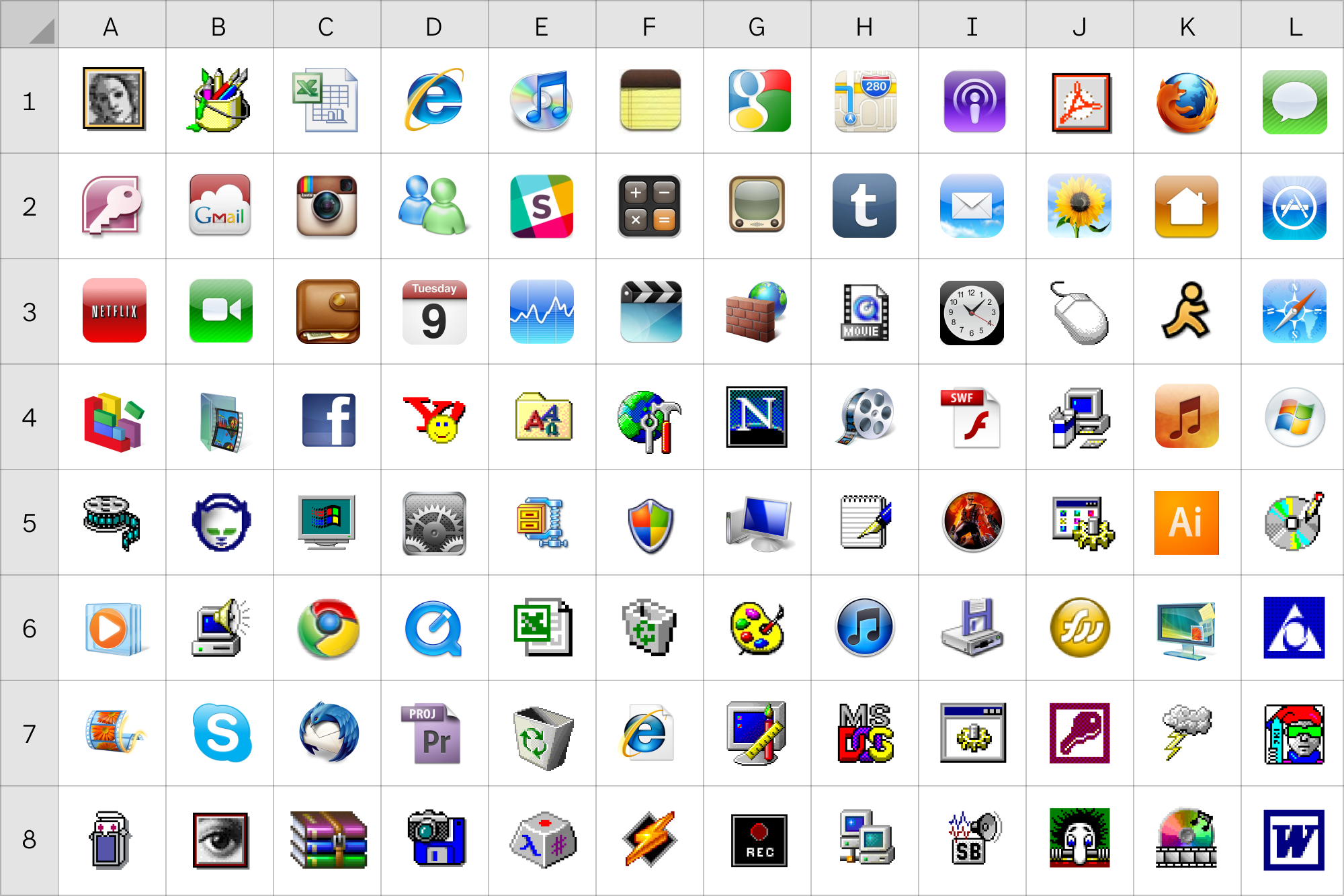
There are 96. I recognize 90. How will you do?
I’ve been going to lots of meetups and conferences recently, trying to read the general room when it comes to the tech industry and AI. I’ve been talking with agency operators, content-management system developers, journalists and product people who work inside of journalism organizations, computer scientists, educators, not-for-profit operators, and insurance people. I’m learning a lot.
I’ll zoom in on two events. First, the Jev meetup at the VC firm Betaworks, which was very well-attended and featured eight Jev demos, held roughly a week after Jev launched (we explained Jev on our latest podcast if you’re curious). Second, the Hacks/Hackers conference on AI and investigative journalism, which was hosted at the offices of the New York Times and had lots of good talks. Both were super-pro and extremely pleasant, and well-run by their hosts (Kaya J. at Betaworks and Burt Herman for Hacks/Hackers).
Jev is a product for software developers that lets you use AI in a very structured way—instead of replying in text, it replies by filling out a multiple-choice question set. Working in this way is much, much faster and much, much cheaper than just asking an LLM to do something. It’s great for things like classifying and sorting documents, or organizing invoices into buckets. When I got to Betaworks, there was already a line out the door, which was fun to see. People had lots of demos, most of which were kind of what you’d expect after only a week, but they were doing real work, too. There were lots of Jev clones to discuss. It was frothy, and reminded me of what I like about technology.
What I took away from it was simple: Nerdy people are still pretty excited about systems that work like computers, instead of like simulated humans. LLMs have remarkable upsides when it comes to parsing and dealing with data and writing code, but getting to a lot of that power just plain sucks and doesn’t work in the fast, cheap way a database works. Talking to a bot every day is frustrating to many programmers (I don’t mind it, personally, but other people do).
Anything that makes AI work more like a normal database is really motivating, because it returns us to a world where systems are functional, predictable, and low-cost, and we can start to do really exciting things, like sorting and organizing a million PDFs, without begging Claude to hear our prayers. I don’t know if Jev can last—OpenAI has already released its own version, called Decisions—but it definitely felt like people were reacting to a new technology that, instead of promising to do your work for you and making up facts, was instead just a normal tool that doesn’t talk too much and can be measured. There was certainly enough enthusiasm that you could get 100-plus nerds to show up just to vibe about it. Also, there was pizza.
At the Hacks/Hackers conference, I wasn’t sure what to expect, because “AI” and “investigative journalism” are not two things that can be combined safely except under very controlled circumstances. Then again, the offices of the New York Times are the definition of “very controlled circumstances.” This was a more formal structure—talks and tracks and coffee in the hallway. There were lots of seasoned journalism professionals and teachers, working to make sense of new technologies; only a few people there seemed to be using LLMs to write for them, while most were building up research tools to help organize things, parsing tons of PDFs, soaking up data from the government to make it searchable, and for the most part, building out tabular data, not generating words.
Two talks stood out for different reasons. The first was by Dylan Freedman and Juliana Castro Varón of the Times. They’re building a very appealing internal product called CheatSheet that looks like a spreadsheet, but you can give it all kinds of data and talk about the columns as a kind of chat. So you list all 50 states in a spreadsheet column and then type, “What are recent changes to the healthcare policy in [state]” and now the AI does 50 boring research queries and summarizes for you, and you can use that to guide your report on national shifts in healthcare policy. From an article describing it by Duy Nguyen:
Cheatsheet features the familiar interface of a spreadsheet but is powered with advanced technical capabilities. Users upload datasets — for instance, a politician’s public statements over the years, police records from information requests or video recordings of city council meetings. Cheatsheet then allows users to apply “recipes” — tested workflows for specific investigative tasks such as quote extraction, summarization, translation, web searching and information classification. Each recipe processes data columns, generating new columns with the results (to witness this is quite a magical feeling).
People I talked to afterwards basically said, “I plan to steal that idea.” (The NYT might open source it, but there are a lot of lawyers employed there—no, even more than you’re thinking—so no one should hold their breath.) It was a real product—it was made by engineers, product people, and designers to serve a team of very demanding users, and you can’t make journalists do anything, so it would need to actually appeal to them and save them time. It uses classic, extremely familiar user interface paradigms: Journalists love Google Docs, so this looked like Google Docs. There was absolutely no talk of whipping it up in a weekend. As a result, we all wanted to try it right away. Remember software? We miss it!
The other talk that stuck with me was by Adiel Kaplan of the Tow-Knight Center for Journalism Futures at CUNY, who discussed using AI “skills” to do deep background research on companies. As a technologist, I always find it incredibly helpful to hear people from outside the industry explain technology—it sort of smacks the smug right out of us. The product she had made was a set of tools that works in Claude Code to heavily research and analyze companies and provide background dossiers.
It was very good and thoughtful, and worked really well. However, to guide us through how it worked, she had to explain a lot about how Claude worked, and we had to go into various settings and flip various switches, and talk through Markdown files.
Looking around at the room I could see that, if you’re not a programmer, working this way is filled with tons of friction. Her “Claude Skill” wasn’t simply a prompt—it called out to APIs, ran code, and did a lot more besides. So it was a product, too, but it ran inside the Claude “runtime.”
In the future, I hope a workshop like this could start with the words “Go to Anthropic and download Claude Skill Builder, and we’ll walk through each step.” Also, the word “Markdown” should never be necessary in polite conversation. But we’re not there yet. I was impressed at what she’d pulled off, but I also felt embarrassed for Anthropic. Which I know is ridiculous. It’s just how I process feelings.
To summarize, I noticed three things:
First: People get really, surprisingly excited when a computer works like a computer instead of pretending to be a person, and can classify lots of documents quickly and cheaply.
Second: People get really, surprisingly excited when a product team builds a product that uses AI but looks a lot like Google Sheets.
And third: Really smart people are building good things with AI, in spite of the AI companies not providing them with good product-building development environments.
To summarize the summary: I did not hear a lot about how AI is evil, or AI is very good. What I kept seeing, over and over, is that people are trying to bring this new technology home to their disciplines and crafts, and that the big labs are not really helping them that much. People are building things that work around that. If they have fewer resources, they have to wrestle with the AI company’s own interfaces. If they have a lot of resources, the things they build look like classic software.
It’s weird that the future looks like spreadsheets. But the future has looked like spreadsheets for 50 years, no matter how many interfaces we try. AI is new and novel, but my bet is that, in time, we will not manage our spreadsheets by talking to bots, but instead we will talk to bots from inside our spreadsheets. Something about humans just loves a nicely sorted grid. We’re funny that way.

I Keep Accidentally Building Search Engines
Ironically, the AI-ification of everything makes this possible—and necessary.

Humans Are the Only Real Agents
A more legible, less terrifying explanation for what’s happening with AI right now—and what we can do about it.
A Brand-New Archive for a Historical Treasure
How we got the full back catalog of Lapham’s Quarterly online.