- Client
-

- Industry
- Climate
Making climate data accessible to researchers, policymakers, and the world
Five years, four major builds, and a stack that stayed deterministic where it counted and AI-powered where it helped.
The challenge
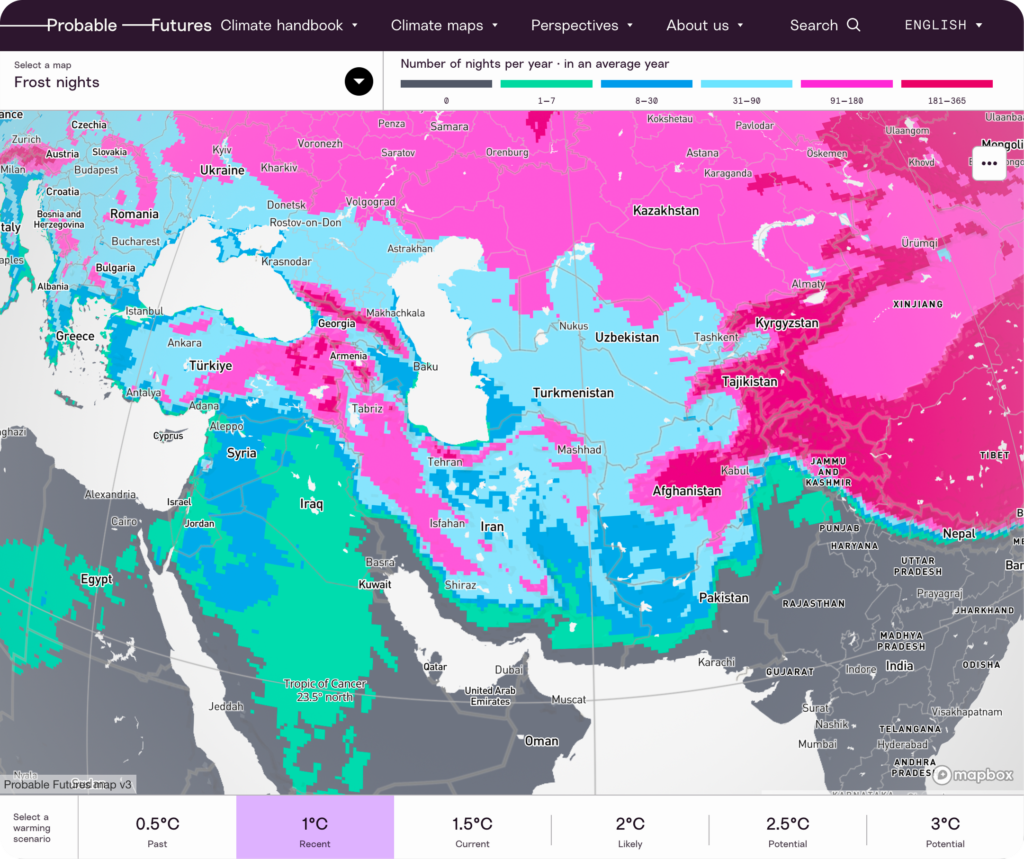
Probable Futures is a nonprofit founded to make climate science legible through interactive maps, plain-language stories, and tools that let people see what a warmer world looks like where they live.
None of that runs on its own. Probable Futures has no in-house engineering team, and its science partner, Woodwell Climate Research Center, delivers raw climate-model files, not a finished product: someone still has to turn 1.65 million data points per dataset into a map that loads in a browser, verify that it matches the source data, and keep publishing as the science and the organization’s ambitions grow.
The organization needed a technical partner embedded closely enough to act like an internal team, one that could keep pace indefinitely and build new maps, tools, and even AI products.
The Aboard solution
Aboard partnered with Probable Futures in 2020 and have stayed embedded with them since.
In that time we’ve built a foundational platform, a professional data tool, and, more recently, a family of AI products built on top of both.
What we delivered
- The original platform (custom CMS, interactive global map tool, GraphQL API, and the climate-data pipeline behind them): kickoff March 2020, public launch September 2021, ~18 months.
- PF Pro, letting organizations upload their own locations and enrich them with climate data: ~1 year to launch.
- PF AI Chat, conversational climate Q&A grounded in Probable Futures’ own published writing: ~10 weeks from zero to deployed.
- Climate Adaptation Tool, climate-risk and adaptation planning for businesses, alongside a browsable Adaptation Library and a new Ask/Plan/Explore experience in beta: ~5 weeks from first commit to first enterprise pilot user.
Key technical achievements
- A fully deterministic, auditable map pipeline: raw science files flow through a database, a geographic export, and Mapbox tiling, with a dedicated validation project whose only job is confirming published maps still match Woodwell’s original data
- Hybrid retrieval for the AI products: vector similarity fused with keyword search, because vector-only search missed the scientific terminology that climate researchers actually use
- Database-level tenant isolation for uploaded data: PF Pro customer data is walled off inside the database itself, not just checked in application code, so an application bug can’t leak one customer’s data to another
- Open by default: major repositories are open-sourced and map packages are free to embed, without ever exposing a credential: part of why Probable Futures’ maps now show up in government toolkits and university courses
- Based on powerful web technology: Postgres with pgvector for hybrid retrieval, OpenAI’s text-embedding-3-small for embeddings, gpt-4o-mini and gpt-5.2 for generation, LangChain and the Vercel AI SDK for orchestration, and Claude (Haiku 4.5, with Opus for synthesis) writing the analytics narratives.
Where AI did the work
AI shows up in two places, and both are additions on top of a deterministic foundation, not a replacement for it.
- Customer-facing: PF AI Chat, the Climate Adaptation Tool, the Adaptation Library, and the Ask/Plan/Explore beta.
- Behind the scenes: an automated monthly analytics report, a report on the developers and analysts using Probable Futures’ public API, and ongoing work to make the site citable by AI answer engines like ChatGPT, Claude, and Perplexity. The original maps, CMS, API, and data pipeline involve no AI at all: those stay fully deterministic, and the AI products read from that pipeline rather than touching it.
Where humans and deterministic systems: did the work
No climate number is ever produced by a model. Instead, when someone asks the chat product about a location, it calls Probable Futures’ own API and retrieves Woodwell’s modeled statistics. Every citation is checked against the specific documents retrieved for that answer, and anything that doesn’t match gets stripped before it reaches a user. Structured AI output is validated against a strict schema: a failure fails the run rather than silently retrying, so a human always investigates.
Results and impact
Usage still accelerating, five years in
The site launched in September 2021 to a press-driven spike, settled to a baseline of roughly 2,000 visitors a month in 2022, and has grown every year since. Most recently, the site saw 79,000 unique visitors in the past 12 months, up 41% year over year, with mid-2026 the strongest stretch in the site’s history outside the launch spike.
Deeper engagement, not just more visits
Traffic to the interactive maps roughly doubled year over year, and per-visitor map interaction is deepening on top of that. Map clicks more than tripled between March and July 2026 alone.
The team shrinks—the product grows
The engineering team went from four to five people at launch down to two today, while the product surface grew from a single website to eight live products and more than 100 releases shipped.
Adopted beyond Probable Futures itself
The open-source map packages have been downloaded roughly 4,200 times, and adoption is accelerating rather than tailing off. Probable Futures’ open data and embeddable maps now show up inside government toolkits, university courses, and other climate products.
Key takeaways
AI handles language, never numbers
Every AI product here retrieves real values from Probable Futures’ own data pipeline and writes prose around them. It never calculates a climate number itself, and it can only cite documents it’s explicitly handed. That single boundary is what makes it safe to point AI at scientific data at all.
Open by design
Public data, embeddable maps, and open-sourced code aren’t a side effect. They’re why Probable Futures’ work ended up inside government toolkits and university courses instead of staying contained to its own site.
Domain fluency is not context, it’s a prerequisite
Making good calls about performance and architecture meant the engineering team had to actually understand the climate science the way Woodwell’s scientists do. On a specialist project, that fluency is a technical requirement rather than optional background reading.
Being honest about uncertainty builds more trust
Probable Futures never gives a single prediction. It gives six warming scenarios, each with a range, and its writing rules explicitly forbid absolute claims. Refusing to be certain is what makes people believe it.
Want to see how Aboard could work for a project like this?
Keep reading
 Government
Taking the headaches out of municipal scheduling for Bostonians
 Life sciences
A hub connecting hundreds of life science entities like never before

 Chemistry
Supercharged R&D platform lets researchers discover tomorrow’s products