
This is who does all the work, late at night after the big people go home.
Six years ago, when we were running a different company, my Aboard co-conspirator Rich Ziade had a great software idea. He called it TinySheet, and it was a ten-line spreadsheet that ran in the browser and kept all the data in its URL. That meant two things:
- The link was the document: There was absolutely nothing saved to a server. (When you put stuff after “#” in a URL, it stays local by default.)
- If you shared the link, the next person could edit the sheet (and pass it on).
Our team did a great job building this utility, and people used it and wrote about it. As far as we could tell, folks mostly used it to share simple math in Slack. Later we launched a similar tool called TinyCalendar.
We moved on, and sadly, those sites fell off the web, and the old links all broke.
Making Tiny Bigger
Now it’s 2026. Rich and I have co-founded a different firm, Aboard. We still build things for ourselves and our clients. And software is very different now. I thought to myself: What if I took Rich’s TinySheet idea and ran with it?
The result is TinyLittleOffice.com. It works using the same principles, but it also has a word processor, outliner, presentation builder, fuller-featured spreadsheet, calculator, drawing tool, diagram maker, animator, calendar, and trip planner. Here it is in my web browser:
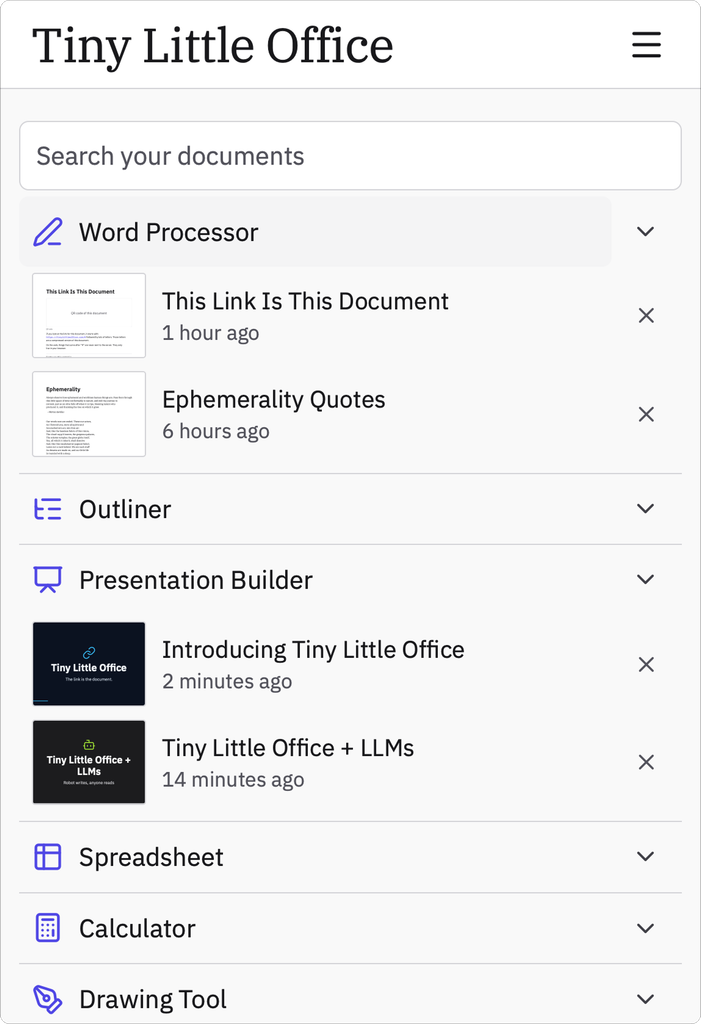
It’s for tiny documents—a couple pages, a few slides. And it still saves all the data in your link.
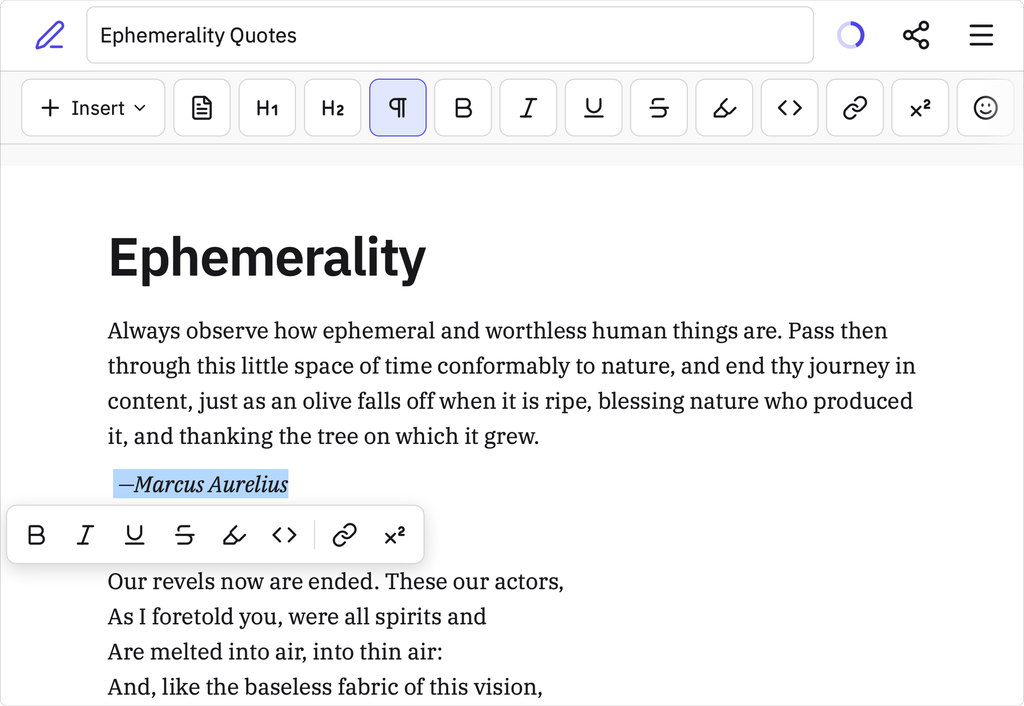
You Don’t Log In, Ever
Say you head to TinyLittleOffice.com and make a document. Now what? When you want to “save” a document you can:
- Copy the URL and paste it into chat. Now everyone in the chat has a copy they can edit. All your ISP can see is that you visited a site—the data is in the link.
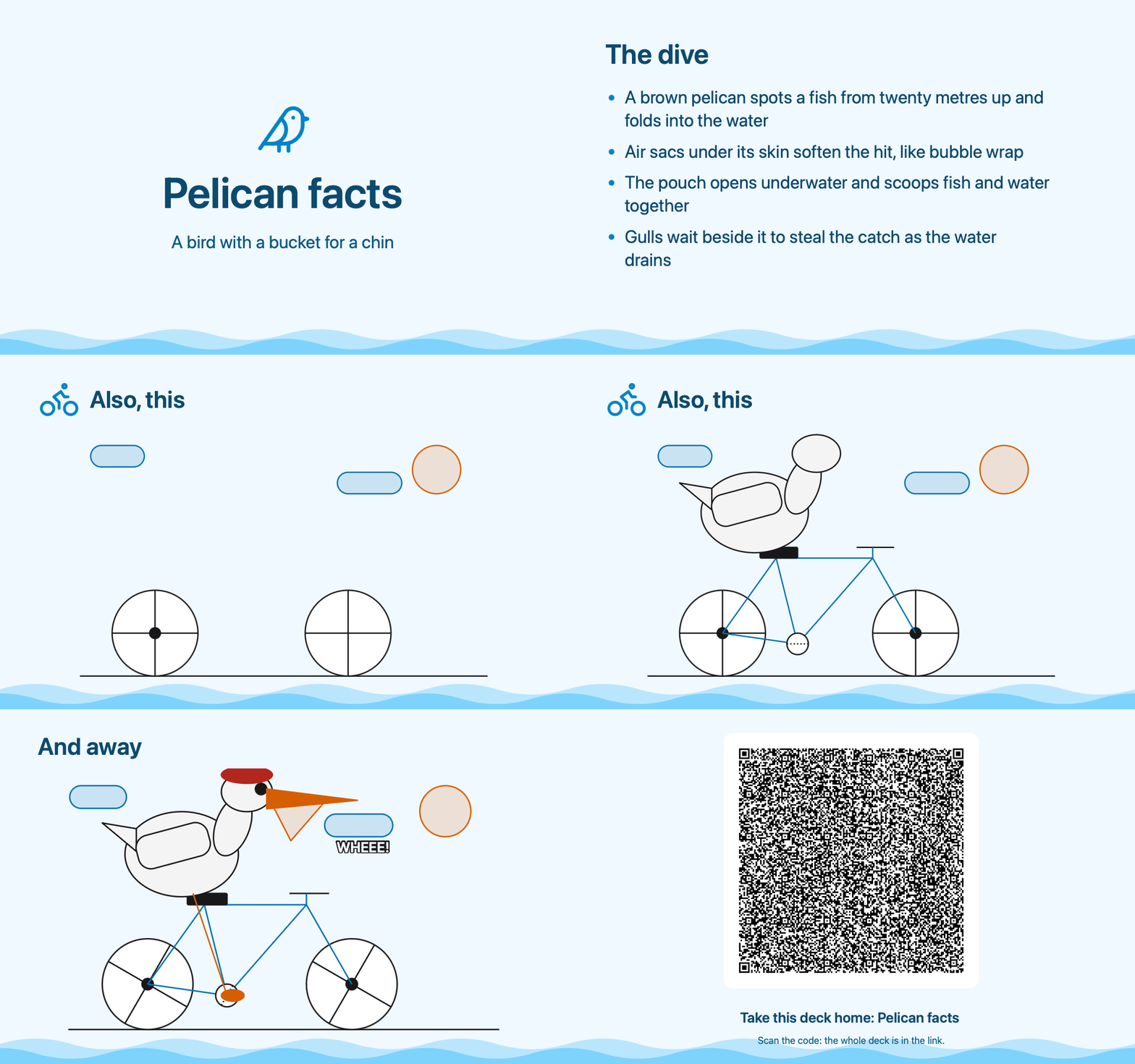
- Export it as a document—PDF, PowerPoint, Markdown. Or as a QR code. If the document is a page or two long, the QR code can contain the whole document.
- Shorten the URL if it’s a bigger doc by saving it to our URL shortener. Your browser encrypts the document and sends that to a server. The “key” is in the link, after the “#”—so the server never sees what you saved. (All links expire, maximum duration is a month.)
There are lots of tradeoffs. This is not, in any way, how web apps are expected to work. The links can get unwieldy pasted in chat, and you can’t upload video or images, full stop. It’s not collaborative like Google Docs. It’s collaborative like handing out zines at a street fair.
I guess there are a few different ways of thinking about it:
- It’s disposable software! You use it and throw it away.
- If Signal was an operating system, this could, one day, aspire to be its productivity suite.
- If you post a full Tiny Little Office link to X or Bluesky, you just “saved” a file in public. (It has a Bluesky account.)
- It was built to make sense to agents—you can tell an LLM to check out TinyLittleOffice.com and use it to make small, shareable things.
But ultimately, it’s just software. It’s for using, and you’ll decide what it’s for and if it meets any of your needs.
In the meantime:
- Here’s a link to a document…explaining how the link is the document…
- And a guide to the whole system…
- And another one explaining the security profile…
- And another explaining the LLM integration.
Small Is Beautiful
Everything in tech is huge right now. Every system lives on someone else’s machine and tracks you everywhere. All the content you make with those systems is being gobbled by LLMs. Meanwhile, most normal people are in chat all day, hiding out from the mess, rambling about politics and sports on WhatsApp or coordinating mutual aid on Signal. I really enjoyed building something for them/us.
I also just kind of…like using this thing. It’s light and it doesn’t give me many options, and when I need to save something I just Slack it to myself. The outliner is my favorite part. It also allows you to embed documents in other documents, which was the dream of the entire 1990s in office software—and now that dream is extremely true.
Rich’s point in producing TinySheet was simple: Small, private things may not be profitable, but they can be valuable. People like little tools they can make their own. It’s your data, and your code. I think all of that holds even more true six years later. And it really is easier to build small than ever before.
This project is open source with the MIT license. Feel free to find fault with it! But I’d also like to see some documents you created. Post them on social media! You can save your essays into Bluesky posts. It beats screenshots of the notes app. Have fun!

An Op-Ed Written by the World’s Best Models
It’s important to hear all sides of the debate.
People Are Reclaiming the Computer
Observations from recent meetups on Jev and AI’s role in investigative journalism.
I Keep Accidentally Building Search Engines
Ironically, the AI-ification of everything makes this possible—and necessary.