I don’t know how we’ll ever get them out.
Jason Scott of the Internet Archive has put up a collection of AI software, games, and tools from past eras. You can play them right in your browser! It’s a good reminder of how “make computer talk” has been a goal for decades—from the era before GPUs, GPTs, or Anthropic claiming a $30 trillion addressable market.
The collection includes classic tools, like the LISP programming language—the original language of AI—and the Eliza chatbot, created 60 years ago by Joseph Weizenbaum, who became rather horrified by how easily people began to spill their secrets to his very simple text generator.
And there’s Racter, a 1980s experiment in “artificial insanity.” As Scott writes:
Racter (short for Raconteur) (MS-DOS version here) is a very early commercial version of a chatbot – it was written to literally write sentences and stories that sounded authentically created, and even wrote some published short works. They sound exactly like you might think they would sound: “Bill sings to Sarah. Sarah sings to Bill. Perhaps they will do other dangerous things together. They may eat lamb or stroke each other. They may chant of their difficulties and their happiness. They have love but they also have typewriters. That is interesting.” This work eventually led to this commercial program, Racter, which you could hold conversations with and which could do a relatively eerie experience of conversations. At the time this program was released (1985), a small trickle of reviews and articles speculated on the ramifications of such a program existing, which look and sound, frankly, like someone bringing a bucket to catch what ultimately is a 100 foot tidal wave coming in from the 21st Century’s shore.
Back in the day, I loved Racter. But as neat as it seemed at first, when you actually used it, it wore out its welcome pretty quickly. Chatbots are funny that way. Seems miraculous, but before long, it gets normal, and then pretty boring. Imagine if cats could talk. It would be the most hilarious, wonderful thing—for about a week. But you’d start to get tired of hearing a pet say, “Please feed me” over and over, and by two weeks you’d be ready to go back to meows. I’m currently seeing lots of people complain about how annoying Claude is as a writer, because it keeps repeating itself. Every time it says “honestly…” it makes their skin crawl. We’re all pretty semantically satiated lately.
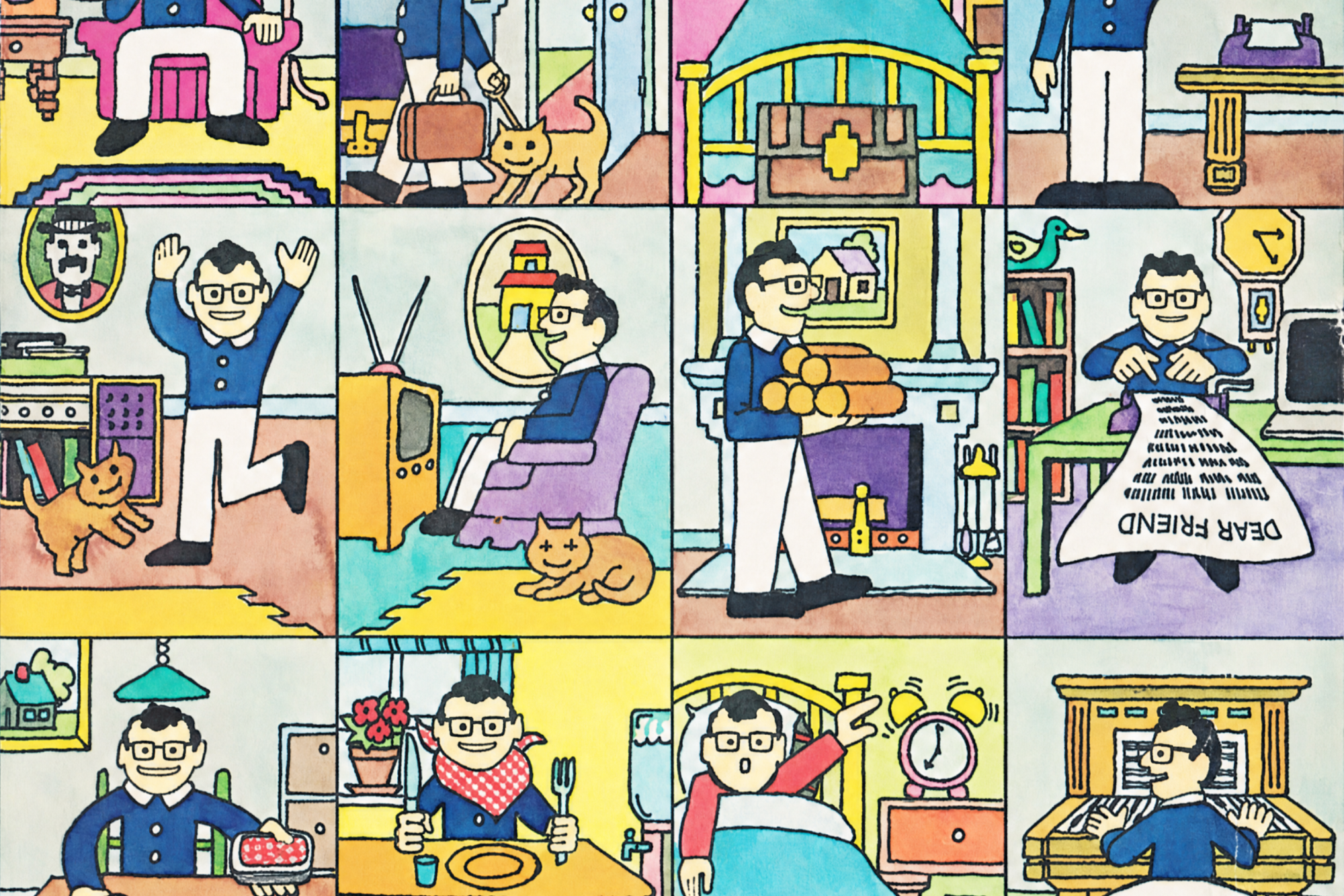
Another program on the list is a game called “Little Computer People” from Activision. It’s barely a game. It features a guy who walks around in a little cutaway view of a house and does chores. I was utterly fascinated by this program back in the day. I wanted to own it so badly, but I couldn’t afford it. Watch a little of it now:
It’s an ancestor of SimCity and the Sims—a miniature version of life you could understand. You could issue suggestions, but the little computer person might ignore them. He’d make a sandwich instead.
Right now, you have Anthropic saying that AI will be equivalent to the entire U.S. economy, and we’ll get there by chatting with Claude. But part of me wonders if we’re not all just playing the most expensive, ridiculous version of the Sims anyone could even imagine: Watching in excitement as the little computer people go about their days inside our computer, writing code for us or doing research projects, then suggesting what they should do next. And you have to wonder if Claude will look to future populations like Racter or Little Computer People look to us today.
The I Ching, the ancient system of divination originating in China, involves casting yarrow stalks or flipping coins a few times and tracking what happens until you create one of 64 hexagrams. Then you could look up what the hexagram means and it tells you your future (many people use the King Wen sequence). You can even run it in LISP, in the emacs text editor. I won’t butcher the subtleties of the I Ching here—it’s a complicated system of divination that has a deep history and, among many things, it utterly blew Bob Dylan’s mind—but if you zoom way out, it uses binary math to look up tokens which can be interpreted to predict the future. Which feels weirdly familiar.
There’s just something about humans that loves to roll the dice (or cast the stalks, or flip the coins) and predict the future and, while the dice may now have many, many dimensions and more than six sides, LLMs fit in with the tradition. Personally, as we go yet further into the “vast sums being thrown around everywhere” FOMO portion of the new technology hype cycle, I’m going to keep reminding myself of that. This isn’t new—this is something humans do. We like to externalize consciousness and predict the next token. And we love simulating little people inside the machine and watching them. It’s part of what we are. We’re weird that way.

People Are Reclaiming the Computer
Observations from recent meetups on Jev and AI’s role in investigative journalism.

I Keep Accidentally Building Search Engines
Ironically, the AI-ification of everything makes this possible—and necessary.
Humans Are the Only Real Agents
A more legible, less terrifying explanation for what’s happening with AI right now—and what we can do about it.