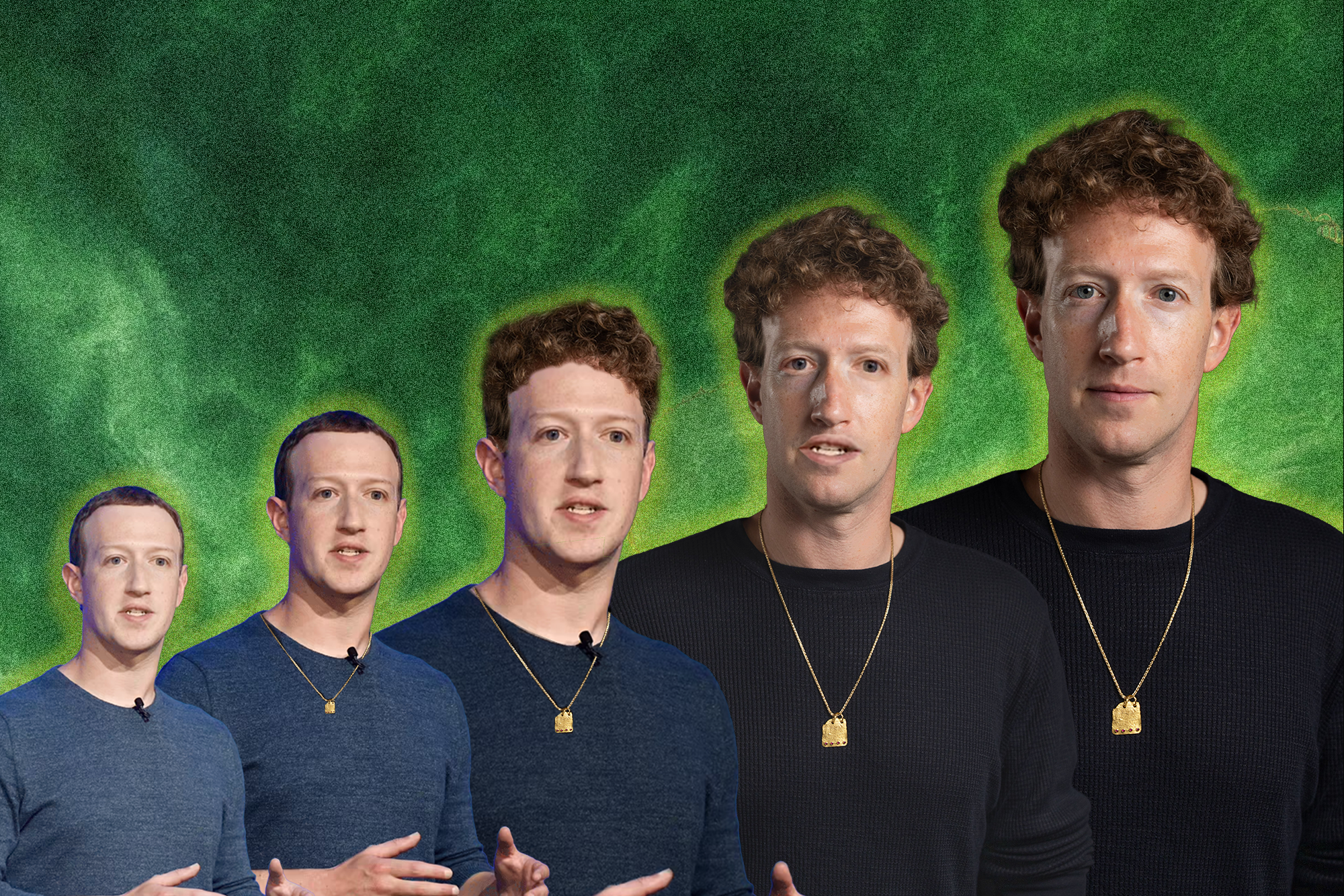
Don’t Yeerk his chain.
Meta CEO Mark Zuckerberg—soon to be portrayed by Jeremy Strong in a movie about how horrible Mark Zuckerberg is—recently published a 6,500 word manifesto called “The Future Is for Everyone.” It’s a big, plain piece of text with no illustrations, much like Dario Amodei writes at Anthropic. It outlines a future where superintelligence is cheap and abundant, where schools are full of eager AI-assisted learners, and a billion small businesses are blooming, all under the benevolent shadow of enormous Meta data centers.
You shouldn’t feel any need to read it. There’s no news or guidance you can use unless you work for Meta. Frankly, it’s not a manifesto or essay as much as nine blog posts in a trenchcoat.
Its primary theme is that AI-enhanced “invention” will drive us into an equitable, positive future, under the guidance of Meta. The secondary theme is that open AI models (like the ones Facebook makes) are good for the world, whereas closed ones (like the ones OpenAI and Anthropic make) consolidate power.
In many ways, I agree with its themes: LLMs are an extraordinary new technology. They can be very empowering, and yes, very dangerous when misused. It is essential that the future involves making many models available to as many people as possible. “Invention” is a powerful focus—digital growth has been monopolized by relatively few companies, and the idea that people could use this new capability to build businesses is quite meaningful. Meta has a vast war chest and is in a position to lead, and they’ve invested billions. And look, while I find the company suspicious, I use Instagram (with a 15-minute limit to avoid depression) and WhatsApp (because I know so many Lebanese people), and we sometimes run ad campaigns on Facebook to promote this very newsletter.
At the same time, Meta is not a transparent company that operates in the public interest. It’s always been oppositional to the open web—we’re still dealing with “link in bio” instead of just “link.” It’s the company that blew billions (maybe not $80 billion, but lots) on the “Metaverse” without much product to show. It feeds people countless videos of AI-generated kittens in little outfits shitting themselves and crying. It’s implicated in a lot of actual war crimes. It has done some grisly things to democracy, keeps trying to silence its internal critics, and faces enormous settlement claims for endangering child safety. Internally, it offers perpetual, rolling layoffs. No one seems proud of the place. The popular understanding of Meta is that it sees humans as raw material to be mulched into a slurry and conveyer-belted to advertisers as fried people nuggets.
This is not the only narrative about Facebook. It’s not even my narrative—it lacks subtlety or balance—but it is a well-trod and extremely popular framing in the public perception. It’s one that a lot of people are bought into, in the same way that they are against data centers and Flock cameras. Hollywood is willing to fund movies with big stars about how bad Meta sucks, not out of great moral imperative, but because it believes that this is a story that people will pay to see. In some ways, the only thing keeping Zuckerberg from being the most hated tech leader on earth is the fact that Elon Musk exists.
And so the real work of an essay like Zuckerberg’s—the baseline it has to hit, coming directly from the CEO—is to own all of this, acknowledge the commercial interests of the company, and offer some kind of vision that resets the public imagination. It cannot be less than a really big swing. Here are the beats it could hit:
- Admit to harms done and remind people that responsibility rests with the CEO.
- Remind us of the scale and opportunity and good things that Meta has achieved, the taxes it pays, the communities it has helped, its relationship to its oversight boards, and its relative maturity in an age of new upstarts.
- Make a single, reasoned argument that America is a land of invention, and how that spirit of invention is part of Meta’s belief system.
- Explain, in depth, how AI is a way to share and transmit that spirit of invention, by empowering people regardless of background, immigration status, educational attainments, or wealth to create new ideas, new businesses, and new creative work.
- Offer a plan for how Meta, with the largest reach on Earth, will be partnering with global organizations and investing billions of dollars into growth, invention, and business development, because even though Meta is big, the world is bigger, and we must work together.
- Explain that it wants to build this world on open platforms because they’ve proven that is what really works—and that this will be good for their business, as the infrastructure provider for this new, transparent world of freely available superintelligence.
- Note that yes, Meta makes mistakes—big ones. Much of the Metaverse didn’t work out, but this is how we learn at scale. This will be a bigger vision and a bigger bet. Join us in building it.
- Offer to collaborate where appropriate on open standards with OpenAI, Google, SpaceX, and Anthropic too. (Pro-forma and not necessarily above-board—but looks nice.)
- Name a set of leaders who will execute this bold vision at great haste, reporting directly to the CEO but operating with great independence.
But we got nothing like that. We got absolute gruel instead:
As a thought experiment, imagine only one person had a superintelligent lawyer. They would have an unfair advantage in court—even if they were wrong on the merits. That would lead to a worse society. But now imagine everyone has a superintelligent lawyer. In this case, justice would be carried out much more fairly and efficiently than it is today when there is often an imbalance in skills and resources in litigation.
I guess you could say one thing in that paragraph’s favor: It was probably written by a human. It reminded me of the scene in Trading Places where Don Ameche and Ralph Bellamy explain the commodities market to Eddie Murphy. Zuckerberg is the Duke Brothers, and we’re all Billy Ray Valentine. We also get this:
For example, in Richland Parish, Louisiana, where Meta is building a large data center, teachers received a $50,000 bonus this year because of the increased tax revenue from our investment. The superintendent told us that teachers are now moving there from across the country and he believes it will become one of the nation’s best school districts.
Come on. People hate you! They also hate data centers! You aren’t going to fix that by helping out some teachers. If you’re going to be cynical then do it properly, at scale. Give everyone in the data center’s zip code free Wi-Fi and unlimited cable—not basic cable, include HBO and all the ESPNs. Just bribe everyone directly for once. Stop lobbying. If you’re going to drop a data center in their neighborhood, give them…well, data. The kind they care about.
The meta-Meta problem with his essay is that Zuckerberg never seems to fully land on an identity as a writer. I mean, why should he? His companies touch billions of people. We adapt to him, not the other way around. But whenever he does this—whenever he gets all statesmanly—it feels like you’re meeting some new version of the man. For a while he was running around the country on a listening tour. Then it was the Metaverse. Then it was MMA and challenging Elon Musk to a cage match. He’s a shapeshifter who’s bad at shapeshifting. The tech Peter Pan, but muscular. The statesman, but he hydrofoils. The Trump fan, but girl dad. The guy who possibly sees himself as a Roman emperor but keeps talking about smoked meats.
Frankly, he’s not even a shapeshifter; he’s the shapeshifter’s little brother. He larps as a shapeshifter. So in the case of his manifesto, he’s fully adopted the mode of Dario Amodei, who writes similar essays, at greater length. But Amodei essays are special because you can literally see the little Men in Black alien pulling the levers inside the brain. Amodei is the mental equivalent of a subway-digging tunnel-borer grinding through stone; Sam Altman is like a forest sprite, transforming into whatever a lonely traveler most desires; and Zuckerberg, oddly, seems caught between—convinced he has to own the future, and putting in the motions, but tired, too.
Then again, none of it matters too much, does it? I’m not the audience. It’s not a literary essay. It’s a CEO talking his book. I’m sure people inside Facebook will appreciate having a positive vision of open platforms and invention, instead of sitting around getting fired all the time.
To write a long essay, you need a deep consistency of thought and deed. You can’t just hop from invention to data centers to open models and expect that to make sense to an audience. By the 3,000th word I got pretty bored—which means the author is probably bored, too. There were still 3,500 words to go. Which, frankly, fair. But it’s actually a very interesting time—why not let someone else take a swing?

An Op-Ed Written by the World’s Best Models
It’s important to hear all sides of the debate.

People Are Reclaiming the Computer
Observations from recent meetups on Jev and AI’s role in investigative journalism.

I Keep Accidentally Building Search Engines
Ironically, the AI-ification of everything makes this possible—and necessary.