Summertime software
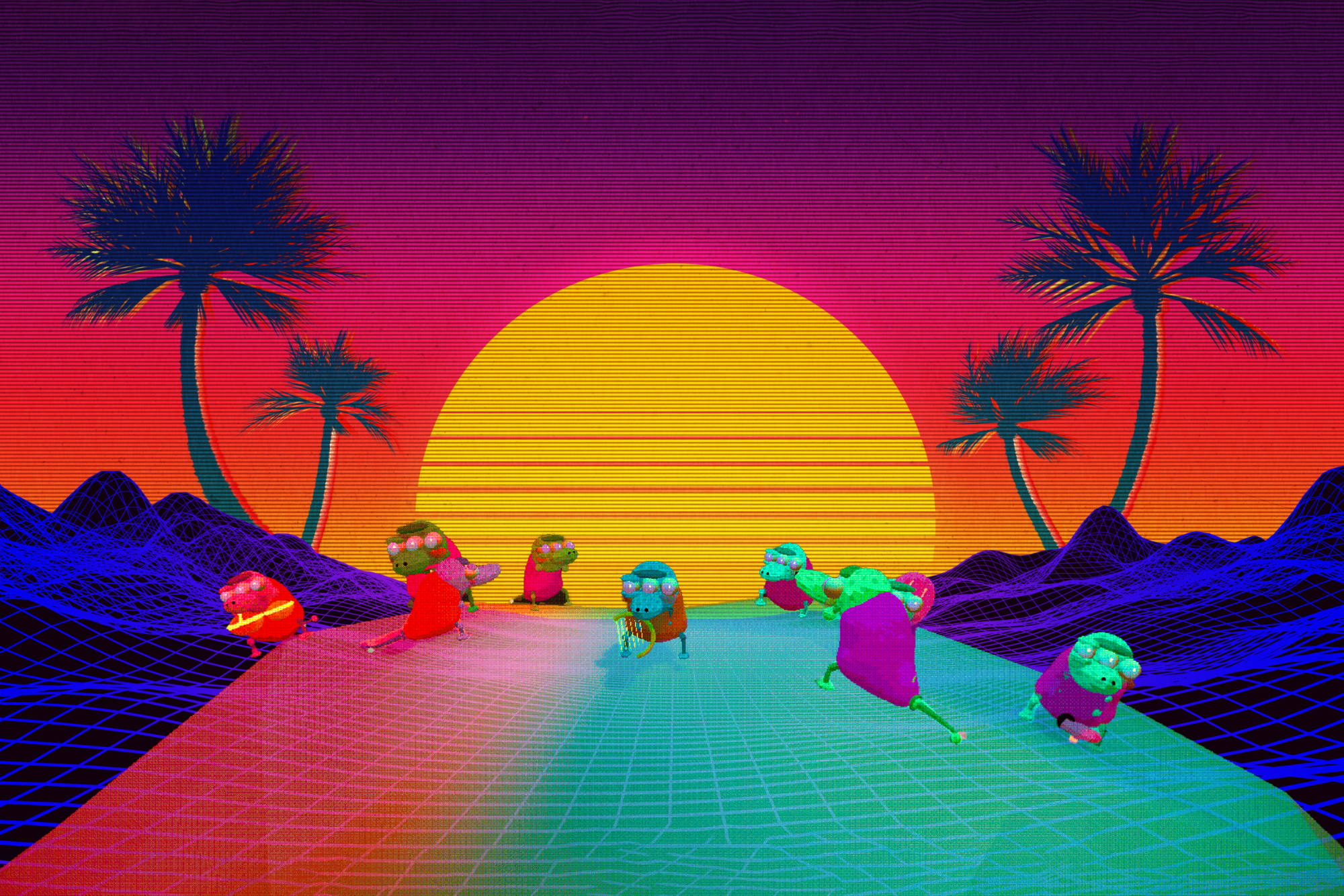
It’s quiet in the office. I’m the only co-founder around, and even our clients are on vacation. That means it’s time to publish the goofiest software I can, before it gets all enterprisey in here again.
Meet Stellate.app. It’s my answer to the question everyone always asks: “What would it sound like to be a ghost walking around the empty mall in an abandoned alien space station while vaporwave-style, sometimes slightly atonal music, in a vast number of imaginary genres, blurs together in the background, layered in with random voices and sound effects?”
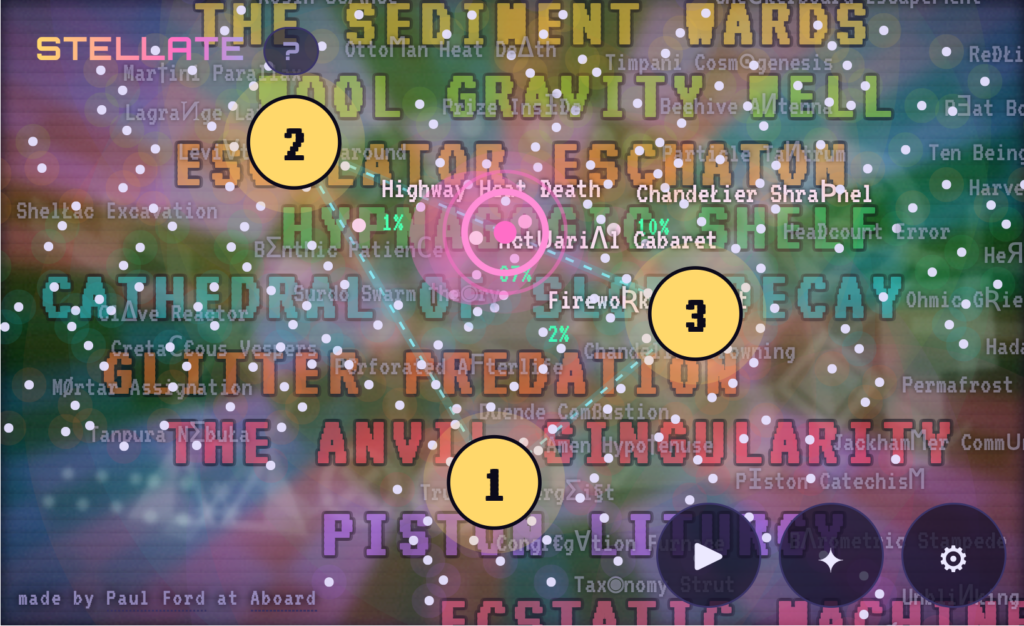
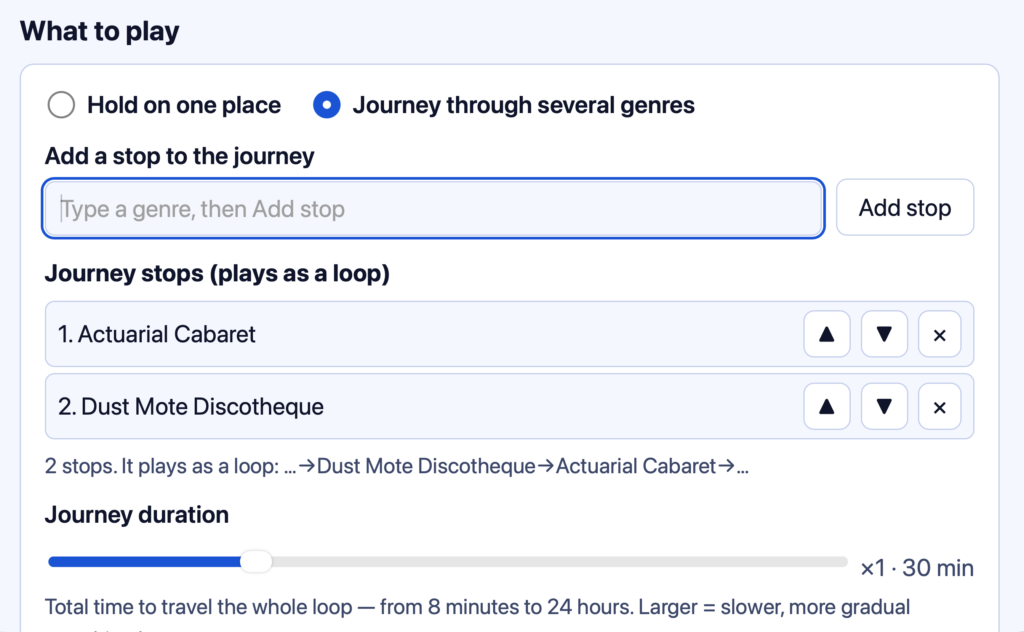
It looks like this:
Look and Listen
As chaotic as it seems, it’s pretty simple: You move the numbers to draw a path between musical genres with funny names, based on real genres like vaporwave, city pop, baroque, and so forth, and the computer dynamically composes music that blends between those genres. The music is not generated by AI, nor does it stream from a server like an MP3. It’s composed, played, and mixed right in the browser, on your computer or tablet/phone. It sounds very, very synthesized—think 1990s Windows game soundtrack—because it is.
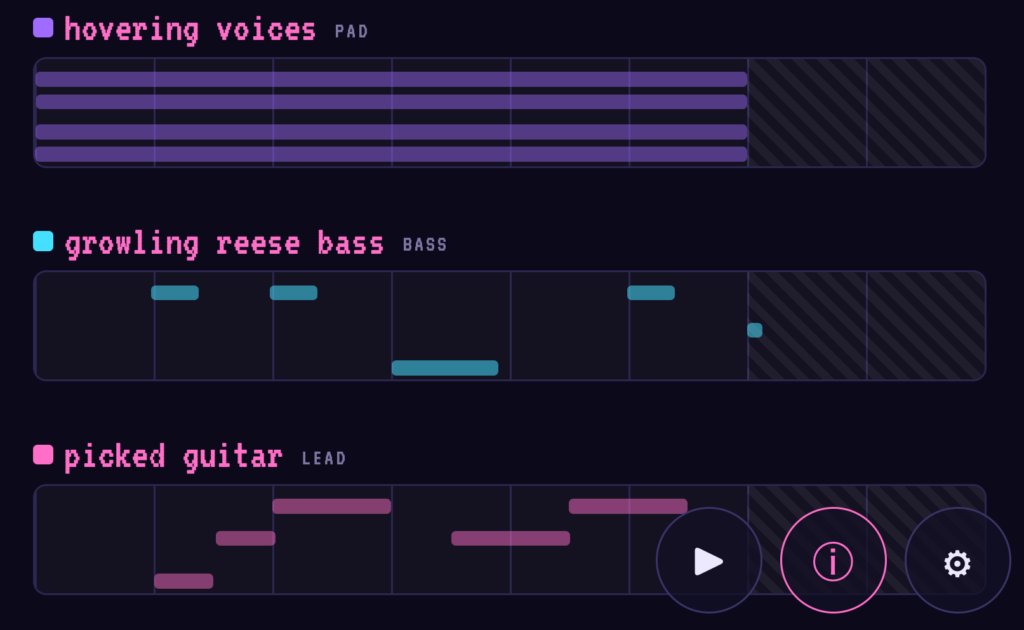
You can see “inside” what it’s playing by clicking the round middle button on the bottom. That shows you how the genre is defined and how the song is composed.
At first, it can shock you with how pretty the melodies and harmonies can be, but after a while, it leaves you feeling hollowed out inside, because it’s a machine with no understanding. I think that’s kind of reassuring.
I’ve poked at it for some weeks now and it feels like a good time to throw it over the wall, while everyone else is at the beach.
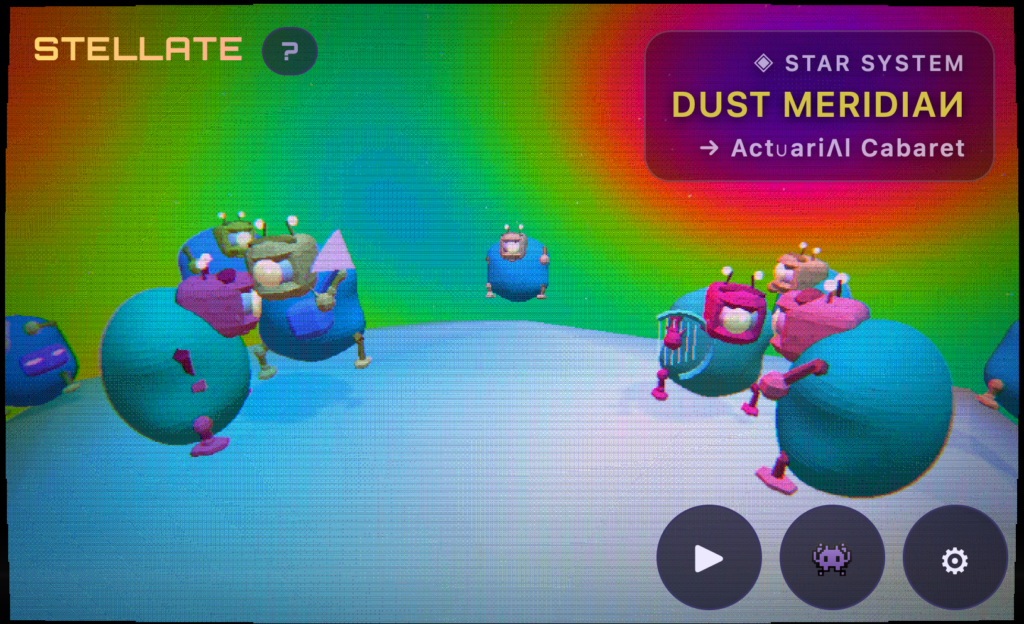
It has other features. For example, if you click the round middle button again, it will bring up a 3D visualization of the galaxy and fly you from one procedurally generated planet to another. On each planet, a band of totally custom aliens will dance and play for you beneath an atmosphere made up of 2D-generated assembly language-driven visualizations, rendered as if it’s on an old TV. I am constantly looking for this exact functionality in software, so I thought it was important to add it.
It also tries to be mobile friendly (at least for iOS), even on older devices, and fully accessible to blind or low-vision users.
How It’s Built
I know I’m supposed to say I did this in one genius prompt then the computer worked for ten hours and it was done. That would be lying. Instead, I dinked around over a couple months, adding up 400 bitsy little prompts, reading the code it produced, listening to it, sharing it with my co-founder Rich and with a musician friend who was both intrigued and horrified, and frequently giving up and coming back a week later.
Eventually, it worked well enough to make me laugh. (One of the genres is called thermostatwave and is all about thermostats and consists of a synthesized voice saying things like “I set it to 68 for a reason” over and over.) I showed some friends and put it on the internal Slack, and other people laughed, too—either at it, or at me.
I used a classic programming technique called “throw everything at the wall with no regard for taste or usability.” It’s summer! Sometimes I did this while riding my bike. One of the most productive coding sessions was at Shirley Chisholm State Park; I’d ride a loop, check Claude’s progress, then ride another loop. I tossed in every frontend technology and technique I could think of. I wanted to see how much I could squeeze out of a web browser in 2026 using LLM-assisted coding, especially while on mobile.
It turns out that’s the wrong framing. A browser in 2026 is a multimedia networked operating system that happens to have HTML as its default view. The browser can do anything a computer can do, but because everyone is trying to hack everything all the time, it’s also built to keep you from doing everything a computer can do. Using LLMs helped me navigate that friction.
On the backend, I kept things simple. Stellate.app doesn’t use cookies; it’s totally GDPR compliant. It uses a simple logging system called GoatCounter that keeps track of aggregate visits, but doesn’t track individual access. It runs on a tiny Digital Ocean server. It’ll cost a few bucks a month to run.
It’s also open-sourced under the MIT License and fully available on GitHub. If you want to use any part of it, have at it. I don’t plan to do anything else with it unless inspiration hits, but if you have any thoughts, please get in touch. I’m obviously all, or at least somewhat, ears.
Goal Achieved
This is a bucket-list project. Since childhood, I’ve wanted to build my own screensaver, and now I have. Let a thousand toasters fly! It’s also fun to do something tacky, noisy, and maximalist—like throwing a glitter bomb.
I’ve decided this is my last solo coding project for a while. Going forward, if I hack a bunch of stuff together, I’m going to check it into our collaboration platform at work, then ask for help. I did that too late on this one—it was mostly done before I asked for feedback—but it would have been a better screensaver if I’d shown it to more people sooner. I think I spend too much time alone with computers these days, even if it is on my phone while I’m riding my bike.
The big goal going forward, for me, for our company, is to talk much less about AI, and to ship way more stuff, collaboratively. Less “why” and more “how.” We have other projects in the pipeline that we will enjoy showing you soon. So far none have dancing aliens (or flying toasters), but here’s hoping.

One of the world’s leading technology thinkers, Paul Ford has written about the way that software works for dozens of publications like Wired, Businessweek, and the New York Times. He co-founded Aboard with Rich Ziade.
More from the newsletter
All issues-
The other AI content paradox
What if you cold-emailed things people actually might want?
-

The big Bun fight
The clash between Bun, Zig, and Anthropic is about more than online drama.
-
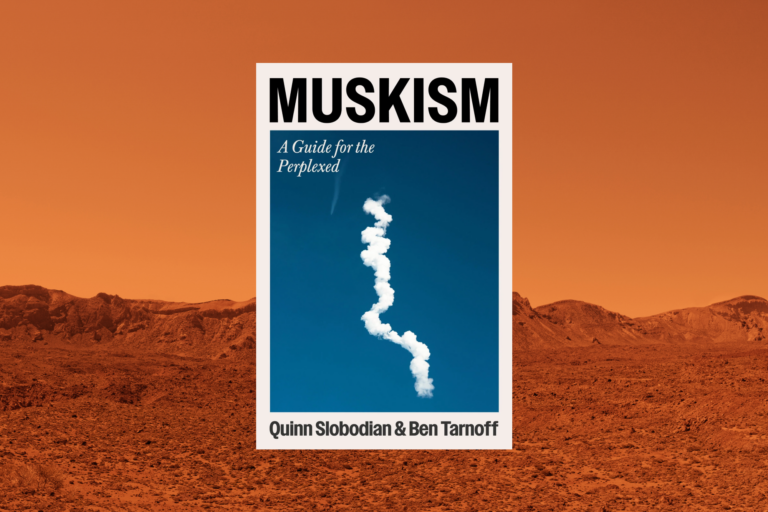
Elon Musk as a philosophy
Muskism breaks down Musk’s world via his actions—but doesn’t illuminate why some still seem to love him.
The Aboard Newsletter
Want more of this?
From Paul Ford and Rich Ziade: weekly insights, emerging trends, and tips on how to navigate the world of AI, software, and your career. Every week, totally free, right in your inbox.