The Great Firmware Flowering

When vibe coding got good, one of the things that really stuck with me was how easy it was to make digital things on systems you didn’t fully understand. I’ve long been a web developer, but I’ve always been “hardware curious”—that is, I wanted to do lower-level coding that ran right on a chip, instead of running a web browser (which runs on top of an operating system, which runs on top of a BIOS, which runs on top of a chip). But that stuff is pretty hard, and every time I tried it, I ended up stumbling through a tutorial, making an LED blink, and calling it a day.
You might ask, “Why would anyone care about that kind of coding?” For every nice laptop you lug around, you likely interact with dozens of firmware-powered devices. It’s the code that runs inside: Street signs and traffic lights have firmware, as do your 3D printer and your printer-printer. Your car has tons of different kinds throughout its many systems. Your router, your stereo, your TV, and your coffeemaker have it, as does your digital camera and smart frame, and your personal fitness tracker, and every single toy that goes beep boop, sitting in a drawer. So do the Voyager space probes and the Mars Rovers. And, of course, every digital music-making device has firmware, too.
Most companies, having sense, try to release as little firmware as they possibly can. Ideally, you put out a digital thing and never have to update it. But of course there are always bugs, and for certain things, like routers or synthesizers or smart TVs, you can extend the lifespan of the platform by updating the software—which means that you don’t have to retool the factory every time consumers want something new, and you don’t have to upgrade the components, either.
This is incredibly true of synthesizers. A company like Roland can make a drum machine and keep it in production for ten years while its component prices come down, and occasionally put out little tweaks that you have to upload via USB sticks, which thrills users who then chat about it on Discord.
So now let me introduce you to a little device called the M-VAVE FM1. This is a very cheap synth: It costs around $50-60 straight from China, maybe 1/10th of what many synths cost. It comes with some little buttons and knobs, and it has a little screen and USB, and runs on a little chip. It sounds pretty good for what it is. It’s a reasonable beep-booper, and it’s pocket-sized, if you’re wearing cargo pants; many of the people who will buy it are wearing cargo pants.
You know how nerds are and where this is going. In October 2026, you can tear out the FM1’s firmware and replace it with literally dozens of different engines—and many more every day—that make it into something totally different than the manufacturer intended. You can do this from Google Chrome, through USB. This has led to a great flowering of websites: An online editor, a firmware hub, genuinely lovely promo websites that double as installers, and just an almost hilarious amount of “because we can” coding and promoting and chatting in general, paired with tons of YouTube tutorials by prominent synthfluencers, which I regret to inform you is a real word people use.
What does the alternative firmware do? It makes the FM1 a full music-production suite. Some make it into a toy; some make it into a music-theory exploration device. Some are incredibly pro with pretty graphics; some are very generic and buggy. Almost all of them are made available for free. Though it’s important to remember that this device is cheap for a reason, and updating it can royally screw it up, as I have learned to my chagrin.
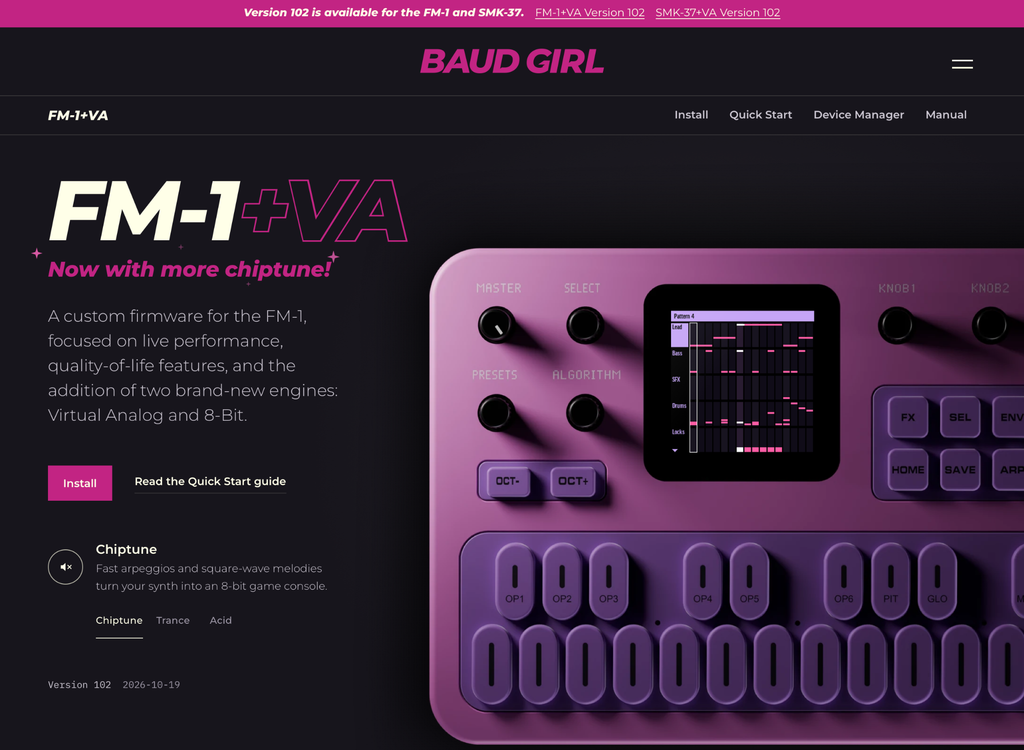
For its part, M-VAVE knows a good thing when they see it, and they’ve leaned into this. But for companies with more expensive platforms, there’s more at stake. The Swedish synth maker Elektron has said, basically, “You do you, but no promises if you hack your gear, and keep it off the official forums.” Meanwhile, the Latvian Erica Synths has released some of its own code as open source and said words to the effect of, “Have a blast.”
There’s a whole world of messy intellectual property assumptions that existed because programming low-level hardware is expensive and error-prone, and now those assumptions are…gone. It’s going to take a while for new responses to emerge. Some platforms might lock down their platforms in new ways, like game systems have been doing for a while—Nintendo actually has special fuses that blow with every update. Some might focus on making their stuff more hackable, but in a structured way, like the Polyend Endless. The only thing we can know for sure is that, in general, users do not care about intellectual property. And if you motivate them, they will try to hack it.
Synths are just the beginning. You’ll find similar conversations in many hobbyist communities, and it’s only a matter of time before we start talking about hacking, well, everything. Look around the room you’re in right now for anything that has a camera, a speaker, or a sensor in it. If there’s a motivated community, every single one of these things could be ripe for hacking.
In some ways, this should scare us. It’ll suck if your bus suddenly speeds up and can’t slow down without exploding—a situation so primally terrifying they made a movie about it (Speed, 1994). Alternately, dorks like me will attempt to install a better icemaker algorithm the night before a big party and brick the fridge, subsequently ruining their marriages. I guess at some level, all we can do is enjoy the ride.
Did I buy an FM1? Of course. I also tried to write my own firmware for it. It worked great for a while, and produced little songs. Somehow, though, I bricked the thing. Black screen, no boops forthcoming. The way you unbrick it is to order a $5 computer and run three wires into a sliced-up USB cable. Doing that and running some special codes gets you access to the FM1 firmware underneath the main firmware, to wake the machine up. That other computer is on the way to me now, and of course it will have firmware of its own, and I have promised myself not to mess with it.

One of the world’s leading technology thinkers, Paul Ford has written about the way that software works for dozens of publications like Wired, Businessweek, and the New York Times. He co-founded Aboard with Rich Ziade.
More from the newsletter
All issues


The Aboard Newsletter
Want more of this?
From Paul Ford and Rich Ziade: weekly insights, emerging trends, and tips on how to navigate the world of AI, software, and your career. Every week, totally free, right in your inbox.