But I love stochastic parrots!
All Polly asks for is a monthly quota of crackers (the $200 pro max plan).
 By ·
By ·

One of the famous criticisms of large language models is that they are “stochastic parrots”—that they randomly assemble language without understanding it. Something about that idea really sticks with people. I think it’s because of, well, parrots, which are fun birds. It brings to mind all kinds of similar creatures: Heuristic toucans, probabilistic osprey, or if we want to get wild and branch out from birds, possibly even syntactic squirrels.
The original paper was by Emily Bender, Timnit Gebru, Angelina McMillan-Major, and Margaret Mitchell; it’s thoughtful and academic. This was the paper that led to Timnit Gebru being fired from Google, but reviewing it a few years later, it seems…measured? It nailed down a lot of concerns about AI bias, for example—some of which have been addressed in AI products, some of which have not.
Many people, especially in the arts and creative industries have doubled down on AI being harmful because it’s just a stochastic parrot. At the same time, people who like AI point to complex AI output and say, “Do you think a stochastic parrot could do this?” before pointing to some awful math problem that was solved by ChatGPT. Other people—like Kevin Kelly—are arguing that we should consider the “emerging self” of AI, with some postmodernism thrown in:
It is entirely possible we come to create a third category for this kind of consciousness and intelligence and selves, that are neither “real”, nor a fake in the mirror. Rather they are what Jean Baudrillard called the hyperreal. An imitation, a reflection, so good that it has its own reality. Maybe what I am seeing in Claude is the first glimpse of a hyperreal self, an artificial self that mirrors human selves so well that it has its own reality.
I come down far from everyone else about this. I think stochastic parrots are great, but I have almost no interest in a conscious computer. I say this as someone who has been learning about automated text generation on computers forever. I’m a huge Eliza fan; I love markup. I worked at an AI startup in 2001 that was focused on statistical models of training. Here’s an article I wrote about RACTER in 2016, already an ancient bit of software. Or a review of the Superintelligence book from 2015.
Back in the day, I wrote all kinds of simple random language generators that came up with brand names, military operation names, or business ideas. The psychoanalyst Carl Jung would tell patients to get their tarot cards read: A way to rattle them, really, and see what stuck. That’s how I see computers at their best: As a way to rattle us, and make us think new thoughts.
So when AI showed up and everyone was saying, “It’s just a stochastic parrot!” all I could think was: Oh my god! A stochastic parrot! I have never wanted anything more in my life. They literally squeezed all the human knowledge they could find into a many-layered language model and it sometimes produces nonsense? This is perhaps the most wonderful thing you could ever do with a computer. After 30 years, those goofballs went and did it!
It contains both the good, enlightened things about humans (it can do math and explain counterpoint) and the very bad things (it has biases and can be easily coaxed into racist thought). It’s the weirdest, most interesting, most terrible object ever, and it squawks whenever you ask it to squawk, in any language.
Then it turns out the stochastic parrot shows that it can do more and more—really amazing tricks. It can summarize text. What bird can do that? Not even crows! It can emit code. It can render images. All Polly asks for is a monthly quota of crackers (the $200 pro max plan).
For a lot of people, AI is here to take their livelihood. I get that. For others, it’s here to replace the entire economy and they plan to become billionaires. Okay. But for me, it’s the most hilarious possible continuation of many decades of continual exploration of what it means to simulate thinking through language—and I never believed things could ever go this far with mere language. I used to be a pro writer for a living, and trust me, no one thought text could ever be this valuable. So to me, the situation we’re in, where LLMs can be prompted to produce interesting, somewhat random output, and then more deterministic systems can evaluate and improve that output (this is how vibe coding works), is, while frequently terrible, perpetually entertaining.
What I don’t understand is why anyone would want a machine to be conscious. I have two children; I do not want to be on the hook to raise a superintelligent robo-baby with access to nuclear launch codes. Also literally every mythological and religious system, as well as much fiction, tells us with clarity that we should not be artificially creating life. The good news is that we can’t even fully simulate a fruit fly brain just yet.
My favorite theory of consciousness is from the anthropologist Richard Leakey. He guessed that consciousness arose in a social context: Maybe one primate saw another with a banana, and did not simply take the banana by force, but instead imagined what the other monkey might be thinking. “If I make a loud noise,” the first monkey might think, “he’ll look at me. And then my other monkey friend could jump in and get the banana.” (Long monkey pause.) “But will my friend eat the banana and not share it?” The monkeys that could simulate other monkeys inside their own monkey brains, and create the best prediction model, got the most bananas, had the most kids, and thus our brains evolved for consciousness.
As a counterpoint, consider this tweet:
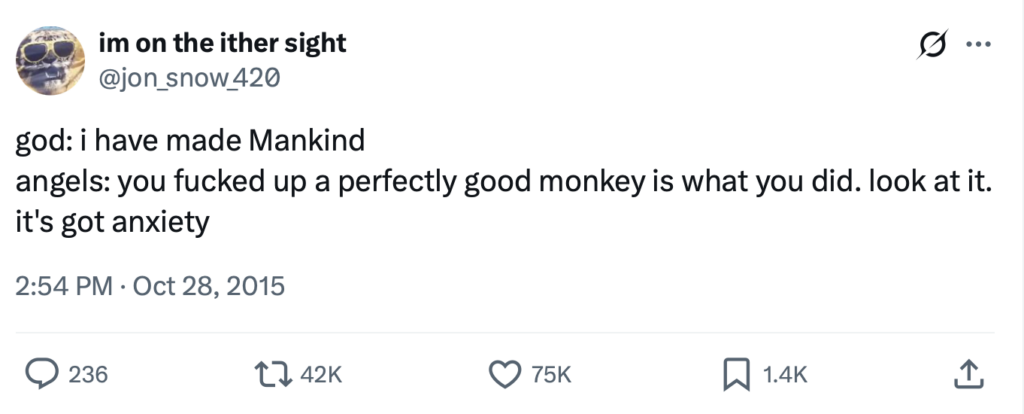
As a deeply digital person, I’ve got an archive of my own email and prose going back nearly 30 years. Sometimes I’ve searched through that archive to learn how my own thinking has changed and evolved. And nearly every time I’ve done that, I’ve learned that my thinking has not changed or evolved. I’ve asked other people about this and they report the same thing. We perceive ourselves as enlightened creatures, adapting to meet the times. But as I started going through prose I wrote in my early 20s…well, I was missing a lot of detail, but the broad ideas were there.
This is why I love the whole stochastic menagerie, from simple random bots all the way up to trillion-parameter LLMs. I see AI as a way to rattle the cage a little—to let us simulate all kinds of monkey behaviors, through language, and try out different modes of consciousness. That’s more interesting to me than it being worth trillions of dollars. I’m not too worried about it deeply changing or wrecking humanity, because humans don’t change anywhere near as quickly as you might read in the papers.
One of the world’s leading technology thinkers, Paul Ford has written about the way that software works for dozens of publications like Wired, Businessweek, and the New York Times. He co-founded Aboard with Rich Ziade.


The Aboard Newsletter
Want more of this?
From Paul Ford and Rich Ziade: weekly insights, emerging trends, and tips on how to navigate the world of AI, software, and your career. Every week, totally free, right in your inbox.